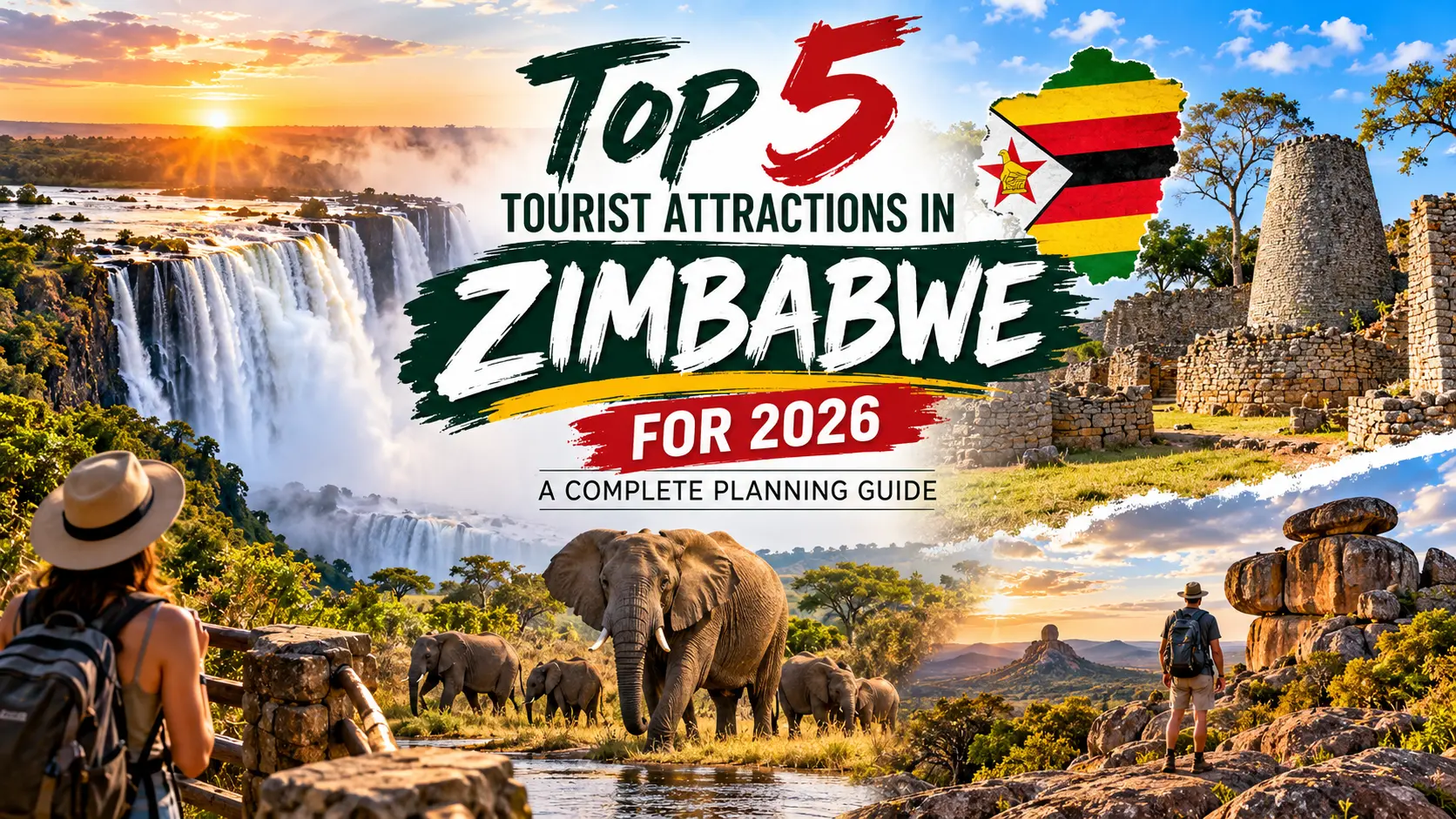

Zimbabwe is easiest to plan when you stop treating it as a collection of separate sights.
Victoria Falls drops 108 metres and stretches roughly 1,708 metres across the Zambezi River. It has been a UNESCO World Heritage Site since 1989. Then there is Hwange, where the safari experience is heavily vehicle-based and elephants are a major draw, and Mana Pools, where walking safaris change the pace completely. Add the granite landscapes of Matobo Hills and the stone ruins of Great Zimbabwe, and you have five attractions that require very different planning decisions.
The problem is not finding places to visit. It is choosing which ones fit your trip.
If you have ten days and want elephants plus the Falls, the answer is Hwange. If you would rather walk than drive, Mana Pools deserves the slot. If Victoria Falls is your priority, timing matters because water levels change dramatically through the year. Great Zimbabwe and Matobo Hills make more sense on a southern or central circuit than as rushed add-ons from Victoria Falls.
That is the useful distinction.
This guide treats Zimbabwe as a route-planning problem rather than a flat top-five list. Each attraction is matched to the traveler it suits, the season that makes the most sense, the amount of time to allow, and the practical details that can derail an otherwise good itinerary.
You will find guidance on park fees, gate hours, road transfers, safari styles, visa considerations, and seasonal trade-offs, followed by a sample itinerary you can adapt to your flight schedule.
Start with the comparison table. Then build the route around your priorities rather than trying to squeeze every attraction into one trip.
Travel information note: Fees, visa requirements, park conditions, opening hours, and transport schedules can change. Verify current details with official Zimbabwean tourism, immigration, park, and attraction sources before booking.
The five attractions serve different travelers
Victoria Falls is the obvious choice if this is your first Zimbabwe trip and you want a major natural attraction with straightforward access and plenty of activities.
Hwange National Park is the stronger fit if elephants and traditional vehicle safaris are your priority.
Mana Pools National Park is for travelers who specifically want walking safaris, canoeing, and a more active wildlife experience.
Matobo Hills works well for travelers interested in dramatic granite landscapes, rhino tracking, rock art, and cultural history.
Great Zimbabwe is the pick for travelers who want archaeology and Zimbabwean history rather than another game drive.
There is no need to force all five into a short trip.
A well-planned Zimbabwe itinerary usually feels better when you give each region enough time to justify the road transfer.
Start with the season
The dry season generally makes wildlife viewing easier because vegetation thins and animals concentrate around remaining water sources. It is also when Zimbabwe’s safari parks are at their busiest and some accommodation prices rise.
The wet season changes the equation. Landscapes turn green, migratory birds arrive, and some camps offer lower rates, but roads can become more difficult and certain seasonal operations may change.
Victoria Falls is different.
Its water level is affected by the seasonal flow of the Zambezi, so the Falls do not look the same throughout the year. High-water periods can produce enormous spray, while later in the dry season some sections on the Zambian side can become much less powerful. The best timing depends on whether you want maximum water volume, clearer viewpoints, or a combination of Falls sightseeing and safari.
That is why the “best month” question has no single answer.
What this guide helps you decide
Use the sections below to answer five practical questions:
- Which attraction fits your travel style?
- How many days should you allow?
- When should you go?
- What fees and entry rules should you expect?
- How does each attraction fit into a realistic Zimbabwe route?
The goal is simple: choose the right combination before you start booking flights and transfers.
The 5 Attractions Compared: Quick-Reference Table
Use this table before you book anything. The attractions are not interchangeable, and the right choice depends heavily on whether you want wildlife, walking, history, or a straightforward Victoria Falls stop.
| Attraction | Best for | Best time to visit | Suggested duration | Approx. entry cost |
|---|---|---|---|---|
| Victoria Falls | First-time visitors, waterfall sightseeing, and adventure activities | Feb–May for high water and maximum spray; Jun–Oct for clearer viewpoints and combining with safari | 2–3 days | Verify current international visitor fee |
| Hwange National Park | Elephant-focused travelers and classic vehicle game drives | May–Oct dry season for concentrated wildlife | 2–4 nights | US$20 per person/day listed in the brief; reconfirm before travel |
| Mana Pools National Park | Travelers who want walking safaris, canoeing, and a more active safari | May–Oct dry season; check seasonal operating dates | 3–4 nights | Verify current international visitor fee |
| Great Zimbabwe | History and archaeology travelers | May–Oct for more comfortable outdoor exploring; open year-round subject to conditions | 1 day / 1 night | Verify current visitor fee |
| Matobo Hills | Rhino tracking, rock art, granite landscapes, and cultural history | May–Oct for rhino tracking and cooler conditions | 2 nights | Verify current park/site fees |
Important: The US$20 Hwange figure should be treated as a planning figure until confirmed directly with ZimParks. ZimParks is the official authority responsible for Zimbabwe’s national parks and provides visitor bookings and park information. Zimparks
How I would choose
Want the simplest first Zimbabwe trip? Start with Victoria Falls + Hwange. The two combine naturally and give you a strong mix of sightseeing and traditional safari.
Want to walk with wildlife rather than spend every game drive in a vehicle? Choose Mana Pools. Its appeal is the safari style as much as the wildlife.
Want history instead of another safari? Add Great Zimbabwe.
Want rhino tracking and dramatic landscapes? Give Matobo Hills at least two nights rather than squeezing it into a rushed day trip.
There is one planning mistake I would avoid: trying to visit all five attractions on a short trip simply because they fit on a map. Zimbabwe’s road transfers take time, and safari parks reward extra nights.
The season changes the experience
The dry season from roughly May to October is the easiest period for conventional wildlife viewing. Water becomes scarcer, vegetation thins, and animals are easier to locate around remaining water sources. It is also the period when safari demand is strongest.
The wet season brings a different Zimbabwe. Landscapes turn green, birdlife becomes more prominent, and Victoria Falls begins moving toward its highest-flow period. Some roads and safari operations can become more difficult, however, so check conditions before committing to a self-drive route.
Victoria Falls needs separate consideration. High water produces enormous spray and power, but that same spray can obscure sections of the Falls from some viewpoints. Later in the dry season, visibility can be better even though the Falls are less powerful.
Victoria Falls: The Zimbabwe Stop to Build Around
If this is your first trip to Zimbabwe, start with Victoria Falls.
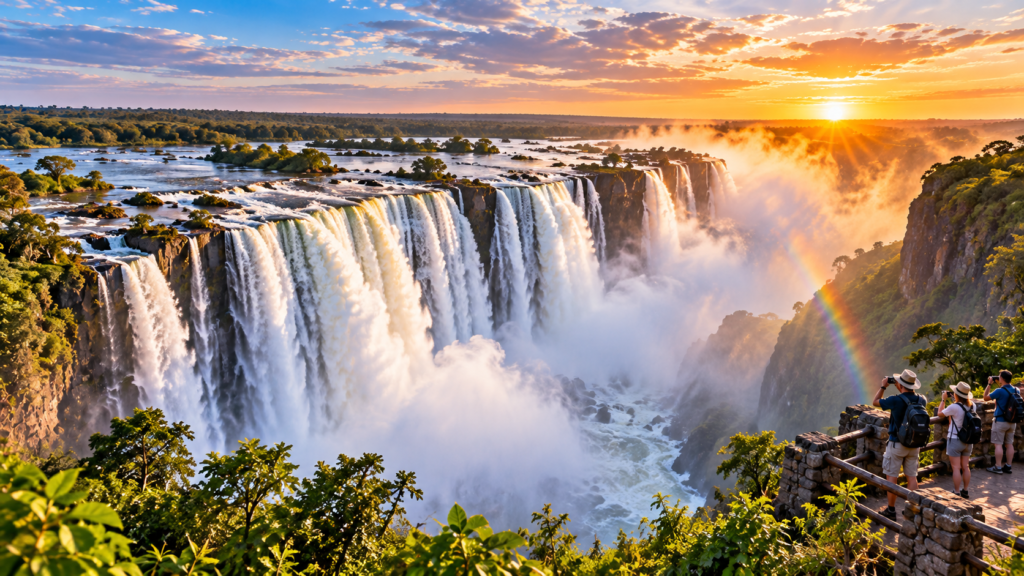
The numbers explain why. The waterfall stretches about 1,708 metres across the Zambezi River, with the deepest point reaching about 108 metres. UNESCO describes Mosi-oa-Tunya/Victoria Falls as the world’s greatest sheet of falling water, and the property has been on the World Heritage List since 1989. Spray from the Falls can be visible from many kilometres away. UNESCO World Heritage Centre
The important planning point is that Victoria Falls changes dramatically with the season.
Visit during high flow and you get enormous volumes of water, heavy spray and a wetter viewpoint experience. Visit later in the dry season and more of the underlying rock formations and gorges become visible, while some adventure activities become more practical.
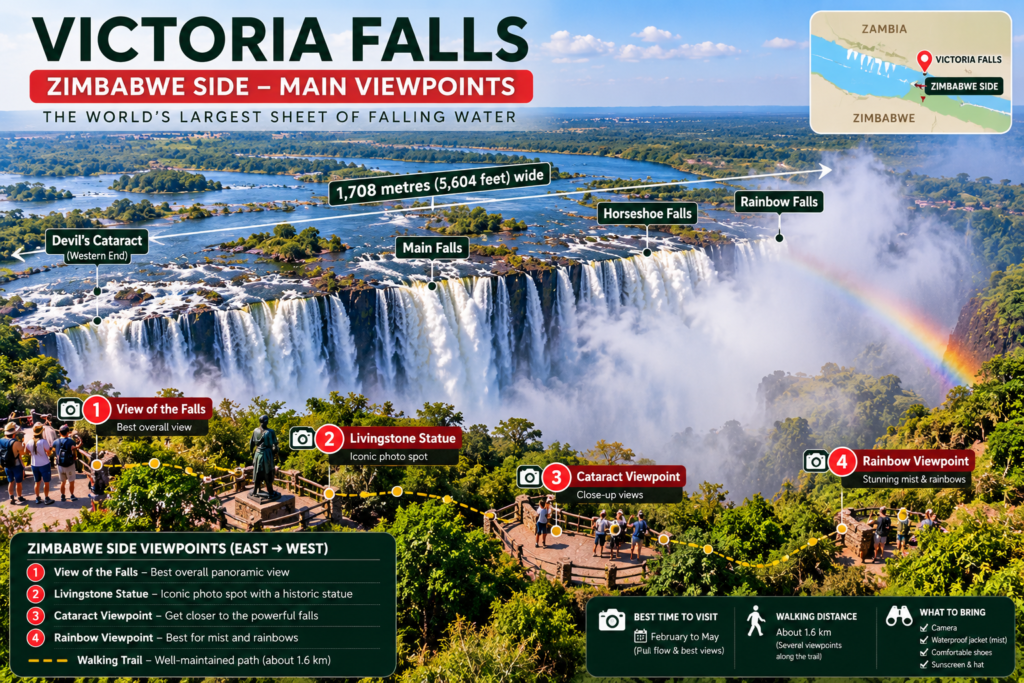
So there is no single “best” month.
Choose based on what you actually want to see.
Victoria Falls Facts
| Detail | Information |
|---|---|
| Location | Victoria Falls, north-western Zimbabwe |
| Width | About 1,708 metres |
| Maximum depth | About 108 metres |
| UNESCO status | World Heritage Site since 1989 |
| World Heritage property | Mosi-oa-Tunya / Victoria Falls |
| Best for | First-time visitors, photographers, adventure travelers, couples |
| Best viewing strategy | Match the season to your priority: flow or visibility |
UNESCO notes that the transboundary World Heritage property covers parts of both Zimbabwe and Zambia. On the Zimbabwean side, Victoria Falls National Park forms part of the protected property. UNESCO World Heritage Centre
Best Time to Visit Victoria Falls
Choose the wet season if maximum water volume is your priority.
The strongest flow generally follows the rainy season, with the Falls building toward peak flow around the first part of the year. The spray can be intense, and some viewpoints can become very wet.
That is spectacular, but it can also make photography harder.
The dry season offers a different experience. Water levels fall, visibility improves at many viewpoints, and the surrounding gorge becomes easier to appreciate. Some adventure activities also depend heavily on river conditions, so rafting and other experiences need to be checked for the dates you are travelling.
For a first visit, I would not choose dates based solely on a generic “best time to visit” chart.
Choose between:
- Higher water: maximum volume, spray and dramatic flow.
- Lower water: clearer views, more exposed rock and better conditions for some activities.
- Shoulder periods: a useful compromise if you want both reasonable flow and clearer viewpoints.
Bungee Jumping, White-Water Rafting and Other Activities
Seeing the Falls from the viewpoints is only part of the Victoria Falls experience.
If you want an active trip, this is where the destination becomes more interesting.
Bungee jumping is one of the headline adrenaline activities around the Victoria Falls area. It is aimed at travelers who want an experience rather than another viewpoint.
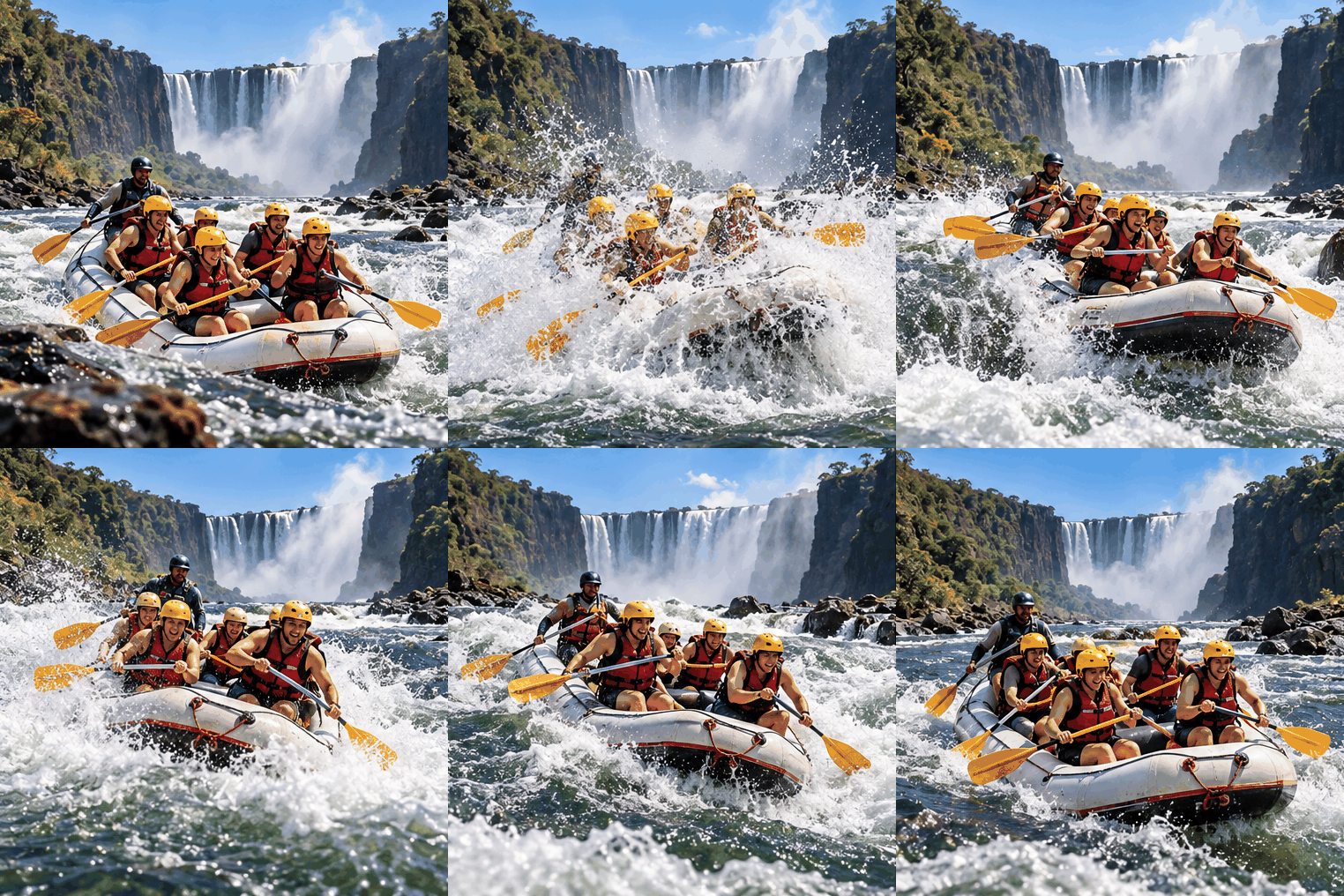
White-water rafting is more dependent on river levels. The Zambezi below Victoria Falls develops serious rapids, but commercial rafting seasons and operating conditions change with water levels. Check the current operator schedule before building your itinerary around it.
Other options include river cruises, helicopter flights, gorge activities and guided walks.
Do not book every activity simply because it is available.
Allow enough time to actually see the Falls.
A good Victoria Falls stay gives you at least two nights, particularly if you are combining the Falls with Hwange National Park.
Practical Details
Victoria Falls National Park is managed by the Zimbabwe Parks and Wildlife Management Authority (ZimParks), which currently lists Victoria Falls National Park among its national parks. Zimparks
The 2026 ZimParks tariff should be checked immediately before publication and again before travel, because visitor and vehicle charges can change. The official 2026 tariff documentation distinguishes between foreign-registered day visitors and accommodated visitors for park-related charges. Zimparks
For your article, avoid publishing an old Victoria Falls entrance fee from a travel blog.
Use the current ZimParks tariff and record the date checked.
Gate hours should also be confirmed with ZimParks because operating hours can vary seasonally.
Zimbabwe Parks and Wildlife Management Authority
How Long Should You Stay?
Two nights is the practical minimum. Three nights is better if you want activities.
With two nights, you can dedicate a substantial portion of one day to the Falls and still have time for arrival, departure and one additional activity.
With three nights, you have room for the Falls, an adventure activity and a slower day without turning every morning into a transfer.
This matters because Victoria Falls works particularly well as the start or end of a Zimbabwe safari.
Who Should Choose Victoria Falls?
Victoria Falls is the obvious choice for:
- First-time Zimbabwe visitors.
- Travelers combining wildlife and scenery.
- Couples and honeymoon travelers.
- Adventure travelers.
- Photographers.
- Travelers with only a few days who want a major attraction without committing to a long safari.
It also combines naturally with Hwange National Park.
If you have ten days and want elephants plus the Falls, Hwange is the straightforward safari pairing. If you would rather spend more time walking, tracking wildlife and experiencing a lower-volume safari environment, Mana Pools deserves the extra logistical effort.
That distinction is more important than simply asking which park is “better.”
Victoria Falls Planning Verdict
Build your itinerary around the season, not the other way around.
For maximum water volume, target the higher-flow period. For clearer views and certain adventure activities, consider the drier months. Either way, allow at least two nights and verify current park fees, gate hours and activity availability before booking.
UNESCO currently lists Zimbabwe as having five World Heritage properties, including Victoria Falls, Mana Pools, Great Zimbabwe and Matobo Hills.
Hwange National Park
If your priority is elephants and classic vehicle safaris, choose Hwange. If you would rather walk or canoe, Mana Pools is the better fit. That is the decision to make before you start comparing lodges.
Size and Wildlife
Hwange is Zimbabwe’s largest national park, covering about 14,650 square kilometres. ZimParks describes it as home to Zimbabwe’s largest elephant population and Africa’s largest population of endangered African wild dogs. The park also supports four of the Big Five: elephant, lion, leopard and buffalo, along with around 100 mammal species and nearly 400 bird species. Zimparks
The elephant numbers are not just a marketing statistic. Zimbabwe’s 2026–2036 Elephant Management Plan retains a 2022 estimate of about 42,157 elephants in Hwange National Park. Zimparks
That scale changes how you should approach a safari here.
Hwange is enormous. You will not see everything by driving around for an hour and ticking off a few species. A good guide matters, and patience matters even more.
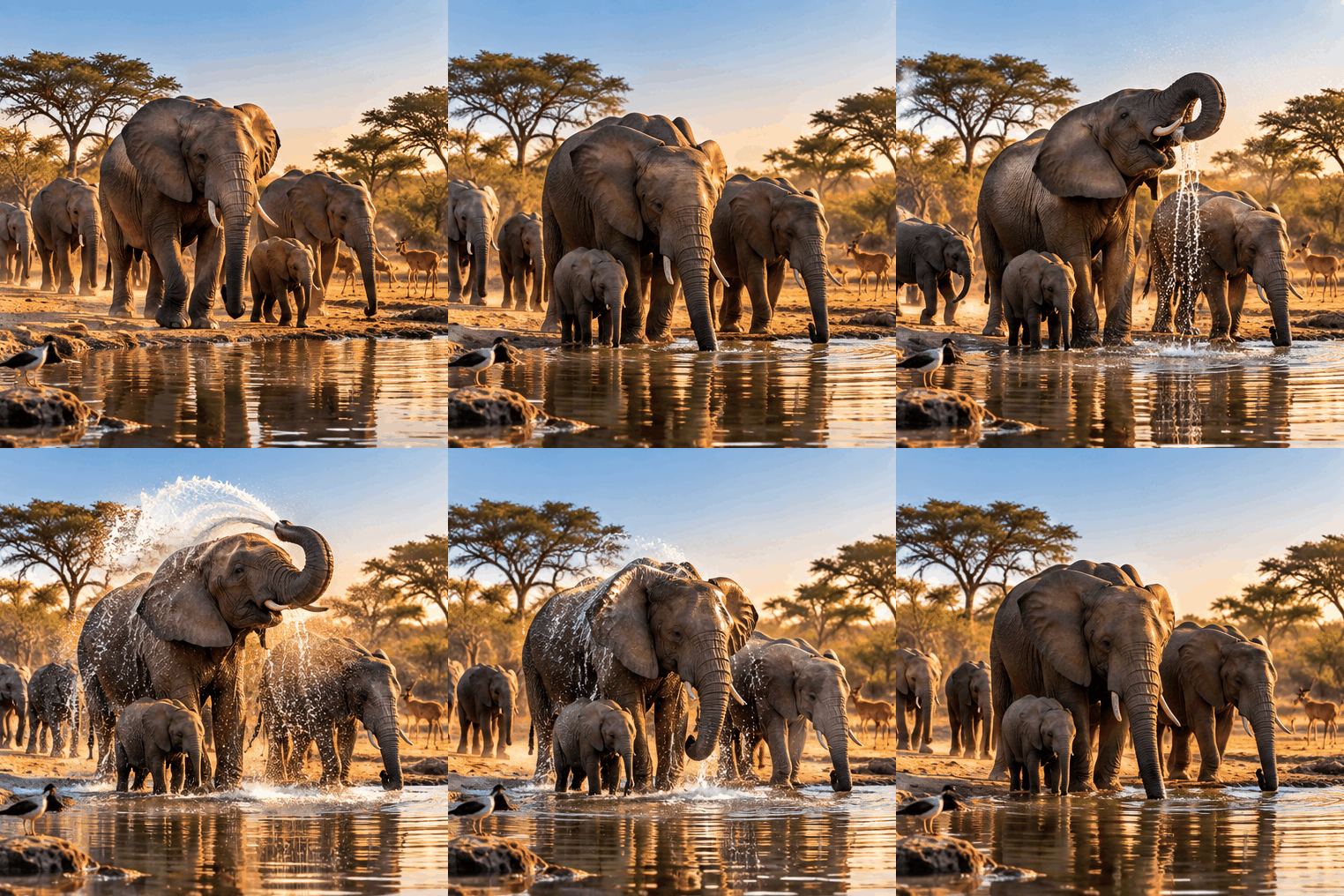
Dry-season waterholes are particularly important. ZimParks notes that Hwange is known for spectacular elephant concentrations during the dry season, when wildlife becomes more concentrated around available water. Zimparks
Wild dogs are a different proposition. They are one of Hwange’s major wildlife draws, but they are not an animal you should expect to find on every game drive. Treat a sighting as a genuine bonus rather than a guarantee.
Best Time for a Hwange Safari
Go during the dry season if wildlife viewing is your priority.
As water becomes scarcer, animals concentrate around permanent and artificial water sources. That can make game viewing more predictable, particularly for elephants.
The trade-off is that the landscape is drier and hotter.
The wetter months bring greener vegetation and migrant birdlife, but thicker vegetation can make some animals harder to spot.
For a first safari focused on elephants, I would prioritize the dry season.
Entry Fee and Gate Hours
The current planning figure in your brief is US$20 per international visitor per day for 2026, but verify the applicable tariff before publishing or travelling. ZimParks publishes park tariffs and can change fees and conditions.
Gate hours should likewise be checked directly with ZimParks before arrival. The planning figure for Hwange is 06:00–18:00, but do not treat an old travel guide as confirmation of current operating hours.
ZimParks – Hwange National Park
This matters because safari timing is tied closely to park access. A sunrise game drive is not something you want to improvise after arriving at the gate.
Safari Style: Vehicle Drives Are the Main Event
Hwange is the straightforward choice for travelers who picture a traditional African safari: open vehicle, experienced guide, early morning drive, waterhole stops and long stretches of watching animal behaviour.
You can spend hours moving between pans and woodland areas looking for elephants, lions, buffalo, giraffes, wild dogs and smaller species.
That is different from Mana Pools.
Mana Pools is particularly attractive if the idea of a walking safari or canoe safari is what excites you. Hwange makes more sense if your priority is covering ground by vehicle and maximizing opportunities to find large concentrations of wildlife.
Neither style needs to be treated as universally better.
They are different safari experiences.
Getting to Hwange
Hwange works extremely well with Victoria Falls.
The distance depends on which part of the park you are visiting. ZimParks gives 172 km from Victoria Falls toward Bulawayo to the Cross Mabale turnoff, followed by another 23 km to the park’s Main Camp. It also lists other access points, including Robins Camp. Zimparks
That means the commonly quoted “about three hours from Victoria Falls” is a reasonable planning approximation for some road transfers, but your actual transfer time will depend on the lodge, camp and road conditions.
For travelers short on time, air access is also possible. ZimParks lists an airstrip at Main Camp for private or charter aircraft, with prior permission required, while travelers can also fly into Victoria Falls International Airport and continue by road. Zimparks
How Many Days Do You Need?
Allow at least two nights.
Three nights is more comfortable if wildlife is the main reason you are coming.
Two nights gives you several game-drive opportunities without stretching the trip. Three nights gives your guide more time to work with changing animal movements and allows you to slow down rather than treating every drive as a checklist.
If you are combining Hwange with Victoria Falls, a practical sequence is:
Victoria Falls → Hwange → onward to your next destination.
That keeps the road transfer sensible and avoids wasting a day doubling back.
Who Is Hwange Best For?
Choose Hwange if you are:
- A first-time safari traveler.
- Primarily interested in elephants.
- Looking for classic vehicle game drives.
- Traveling with family and prefer a conventional safari format.
- Interested in photographing large mammals.
- Hoping to see African wild dogs.
- Combining Victoria Falls with a Zimbabwe safari.
- Short on time and want a relatively straightforward safari route.
Hwange vs. Mana Pools: Make the Choice Early
If you are stuck between the two, ask one question:
Do you want to drive or walk?
Choose Hwange if your priority is elephants, waterhole viewing and classic vehicle safaris.
Choose Mana Pools if your priority is walking, canoeing and a more activity-led safari experience.
Hwange also has a major logistical advantage for a first Zimbabwe trip: its proximity to Victoria Falls makes it easy to build a Falls-plus-safari itinerary.
Hwange Planning Verdict
Hwange earns its place in a first Zimbabwe itinerary because it delivers the classic safari experience without requiring you to build the entire trip around a remote park.
Its size is both the attraction and the challenge. Give yourself enough nights, use a knowledgeable guide and prioritize the dry season if elephants and concentrated wildlife viewing are your main goals.
Mana Pools National Park
If you would rather walk beside wildlife or paddle past hippos than spend every safari in a vehicle, choose Mana Pools. This is the Zimbabwe park for travelers who want the safari itself to feel like an active wilderness experience.
UNESCO Status and Scale
Mana Pools is a UNESCO World Heritage Site and forms part of the larger Mana Pools–Sapi–Chewore landscape along the Zambezi Valley. The World Heritage property covers more than 6,700 square kilometres, including Mana Pools National Park, Sapi Safari Area and Chewore Safari Area. UNESCO recognizes the area for its exceptional wildlife and relatively intact floodplain ecosystem.
The name comes from the Shona word mana, meaning “four,” referring to the four permanent pools that remain from former channels of the Zambezi.
Those pools matter because water drives the wildlife experience.
Mana Pools is particularly known for its large concentrations of hippos and crocodiles, as well as elephants, buffalo, lions, wild dogs and a wide range of other wildlife. The Zambezi floodplain creates a very different environment from Hwange’s dry woodland and waterhole landscape.
Walking and Canoe Safaris
This is where Mana Pools separates itself from Hwange.
Walking is the attraction.
A guided walking safari changes how you experience wildlife. You are no longer sitting several metres above the ground in a vehicle. You are moving through the same environment on foot, paying attention to tracks, wind direction, sounds and animal behaviour.
That does not mean walking directly toward dangerous animals. Professional guides control the distance and approach, and the experience depends on understanding animal behaviour and maintaining appropriate safety protocols.
Elephants are one of the park’s signature encounters.
You may also encounter buffalo, antelope and other wildlife while walking between the floodplain and woodland.
Then there is the Zambezi.
Canoe Safaris on the Zambezi
A canoe safari gives you another perspective.
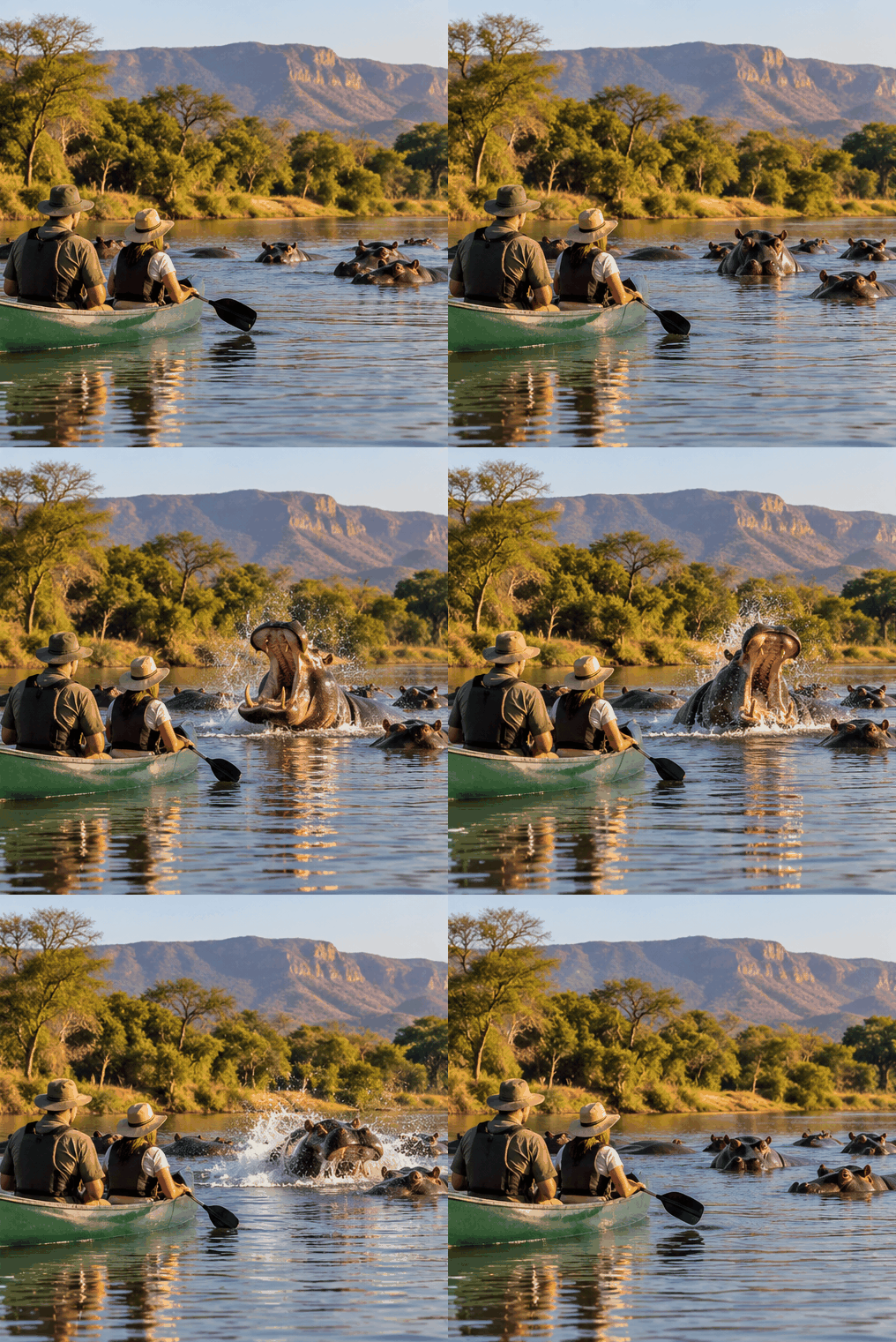
Instead of driving between sightings, you move quietly along the waterways with a guide. Hippos may be visible in the water, while crocodiles can lie along the banks.
It is a very different pace from a vehicle game drive.
You cover less ground, but you spend more time interacting with the landscape.
That distinction is important when choosing between Mana Pools and Hwange.
If your priority is seeing as many large mammals as possible from a vehicle, Hwange makes more sense.
If your priority is the experience of being on foot or on the water, Mana Pools is the stronger match.
Dry-Season Operation
Mana Pools is strongly seasonal.
Plan around the dry-season operating period, generally from May into October, rather than assuming the park functions like a year-round safari destination.
The dry months are important for both access and wildlife viewing. As water becomes more limited across the wider landscape, animals concentrate around the remaining water sources and the Zambezi floodplain.
October can be particularly hot, but it can also produce excellent wildlife concentrations.
May and June bring more moderate conditions after the rains, while later dry-season months become hotter and progressively drier.
Check current park access and lodge operating dates before booking.
Do not build a Mana Pools itinerary around a wet-season visit without confirming that the specific camp, road and activity you want is operating.
Remote and Low-Key Safari Style
Mana Pools requires more commitment than Hwange.
That is partly the point.
The park is remote, and the experience is less about moving quickly between multiple attractions and more about staying in one wilderness environment for several days.
You should expect:
- Longer road transfers or charter-flight logistics.
- Fewer conventional tourist facilities.
- Seasonal camp operations.
- Guided walking and canoe activities.
- More emphasis on wildlife behaviour than ticking off species.
- A smaller-scale safari atmosphere.
This is not the place to arrive with a rigid checklist of ten animals you need to photograph.
Give the guides time to work.
Mana Pools vs. Hwange
The difference is straightforward:
| Mana Pools | Hwange | |
|---|---|---|
| Main safari style | Walking and canoe | Vehicle game drives |
| Best for | Active safari travelers | Classic safari travelers |
| Wildlife setting | Zambezi floodplain | Dry woodland and waterholes |
| Season | Mainly dry-season operation | Year-round safari potential |
| Access | More remote | Easier to combine with Victoria Falls |
| Elephant viewing | Excellent | Major strength |
| Canoe safari | Yes | No |
| Walking safari | Major attraction | Available in selected areas/operations |
| First-time safari | Best for travelers seeking a more active experience | Straightforward choice for a classic safari |
If you have ten days and want elephants plus Victoria Falls, Hwange is easier to build into the route.
If you have more time and the phrase walking safari immediately interests you, Mana Pools deserves serious consideration.
How Long Should You Stay?
Allow at least three nights if you are making the effort to reach Mana Pools.
Two nights can work, but the logistics make a short stay less attractive. You want enough time for multiple walking or canoe activities and enough flexibility for weather and wildlife conditions.
Three to four nights gives the park room to work on its own terms.
That is especially important here because a safari is not a theme park schedule. Wildlife does not appear because your itinerary says 10:00.
Who Is Mana Pools Best For?
Choose Mana Pools if you are:
- An experienced or repeat safari traveler.
- Interested in walking safaris.
- Interested in canoe safaris.
- Comfortable with remote accommodation.
- Happy with a slower safari pace.
- More interested in wildlife behaviour than a species checklist.
- Looking for a quieter alternative to a conventional vehicle safari.
- Comfortable planning around seasonal park operations.
It is less suited to travelers who want a highly structured first safari with easy road access and multiple daily vehicle drives.
Practical Planning Note
Mana Pools is part of a UNESCO World Heritage property, but UNESCO status does not mean the park operates like a conventional sightseeing attraction. The remoteness is central to the experience.
Confirm park fees, gate hours, seasonal access, road conditions and camp operating dates with ZimParks or your lodge before travelling. Conditions in remote parks can change, and a current operator schedule is more useful than an old itinerary published online.
Mana Pools Planning Verdict
Mana Pools is the choice for the traveler who wants to participate in the safari rather than simply watch it from a vehicle.
Walk with a guide. Paddle the Zambezi. Spend several days in one landscape.
But plan around the dry season and accept the extra logistics.
If you want easy access, vehicle game drives and dependable elephant viewing around waterholes, choose Hwange. If the idea of a walking or canoe safari is the reason you are coming to Zimbabwe, put Mana Pools near the top of your route.
Great Zimbabwe
Great Zimbabwe is the stop to choose when you want to understand where Zimbabwe’s name and much of its archaeological identity come from, rather than spending the entire trip watching wildlife.
The ruins are not a small collection of isolated stones. They are the remains of a major medieval African settlement built from granite blocks without mortar. The site represents the achievements of the Shona-speaking societies that developed in the region and flourished through trade and agriculture.
The Ancient Stone City
Great Zimbabwe was constructed using carefully shaped granite blocks laid without mortar. Its builders created substantial walls, enclosures and elevated structures across a large settlement.
The name Zimbabwe is closely associated with these stone structures. UNESCO lists Great Zimbabwe National Monument as a World Heritage Site and describes it as the largest medieval stone-built complex south of the Sahara.
That makes the site particularly important for travelers who want to understand Zimbabwe beyond its national parks.
The most recognizable part is the Great Enclosure, with its enormous curved stone walls. Other areas of the ruins extend across the surrounding landscape, so this is a place to explore rather than simply photograph from one viewpoint.
Why Great Zimbabwe Matters
Great Zimbabwe changes the balance of a Zimbabwe itinerary.
Victoria Falls gives you a major natural attraction. Hwange and Mana Pools give you wildlife. Matobo combines landscape, wildlife and archaeology.
Great Zimbabwe gives you history.
The settlement was part of a sophisticated regional society connected to wider Indian Ocean trading networks. Archaeological evidence shows that Great Zimbabwe was not an isolated settlement but part of a broader economic and cultural system.
UNESCO identifies the site as evidence of a powerful medieval kingdom and notes its importance as an example of the development of the Bantu civilization of the southern African region.
That historical context is worth understanding before you arrive.
Otherwise, it is easy to see Great Zimbabwe as impressive stone walls without appreciating what created them.
What to See and Do
Plan to explore the site on foot.
The walls and enclosures are spread across the archaeological landscape, and walking between them gives you a better sense of the settlement’s scale.
Focus on the major architectural areas rather than rushing through for photographs.
A local guide is worth considering, particularly if archaeology and history are important to you. The stones themselves cannot explain the settlement, its trading connections or the societies that built it.
Allow enough time to walk comfortably, especially during hotter months.
Wear proper walking shoes, carry water and avoid treating the site as a quick roadside stop.
Best Time to Visit
Great Zimbabwe can be visited throughout the year.
The dry season from May to October generally provides more comfortable conditions for walking and exploring, with lower rainfall and clearer conditions.
The wet season brings greener surroundings but can also mean rain and more difficult conditions on some routes.
If Great Zimbabwe is part of a larger southern Zimbabwe itinerary, build it around the other stops rather than making the season decision solely for the ruins.
How Long Should You Stay?
A half day is enough for the main archaeological visit, while an overnight stay makes more sense if you are combining Great Zimbabwe with other southern Zimbabwe attractions.
Do not underestimate the travel distances.
Zimbabwe is large, and a map can make two destinations look deceptively close. Road-transfer time matters when building an itinerary.
Who Is Great Zimbabwe Best For?
Choose Great Zimbabwe if you are:
- Interested in African history and archaeology.
- Traveling beyond the traditional safari circuit.
- Interested in Zimbabwe’s cultural heritage.
- Looking for a UNESCO World Heritage Site.
- Traveling with someone who does not want every day to involve wildlife drives.
- Building a southern Zimbabwe route with Matobo Hills.
If your trip is only five days, you may need to prioritize.
If you have ten days or more, Great Zimbabwe becomes much easier to justify.
Great Zimbabwe Planning Verdict
Do not treat Great Zimbabwe as a filler attraction between safari parks.
It provides the historical context that the wildlife-focused parts of Zimbabwe cannot.
Give the ruins a few hours, use a knowledgeable guide if history matters to you, and combine the site with Matobo Hills for a stronger southern Zimbabwe route.
Matobo Hills
If your priorities are rhino tracking, rock art and unusual granite landscapes, put Matobo Hills on the itinerary.
This is one of Zimbabwe’s most varied attractions because you can combine wildlife, archaeology and scenery in the same visit.
Granite Hills and Rock Art
Matobo is defined by granite.
Huge rounded rock formations rise across the landscape, creating a setting that looks completely different from Hwange’s woodland or Mana Pools’ Zambezi floodplain.
The Matobo Hills Cultural Landscape is a UNESCO World Heritage Site. UNESCO recognizes both the area’s natural formations and its long cultural history, including archaeological sites and extensive rock art.
The rock paintings are particularly important.
Ancient communities used caves and rock shelters across the hills, leaving paintings that provide evidence of long human occupation and cultural activity.
This is why Matobo should not be approached simply as another game park.
The landscape itself is part of the attraction.
Rhino Tracking
For wildlife travelers, the major reason to come is rhino tracking.
Unlike a conventional vehicle game drive, tracking involves walking with trained guides through the landscape to locate rhino and interpret signs of their movements.
That changes the experience completely.
You are looking at tracks, vegetation and terrain rather than simply scanning from a safari vehicle.
Rhino sightings can never be guaranteed, but Matobo is an important Zimbabwe destination for travelers specifically interested in rhino.
The dry season is generally the most practical period for tracking, because vegetation is less dense and walking conditions are usually more predictable.
Follow the guide’s instructions closely.
Rhino are large, powerful wild animals, and this is not an activity where you improvise your own approach.
Cultural and Scenic Variety
Matobo’s biggest advantage is variety.
You can spend part of the day tracking rhino, then explore rock-art sites or granite formations.
That makes it particularly useful for travelers who want a wildlife experience without committing every day to conventional vehicle safaris.
It also works well geographically with Great Zimbabwe.
A southern Zimbabwe route can therefore combine:
Great Zimbabwe → Matobo Hills → Bulawayo
rather than forcing these attractions into a northern Victoria Falls and Hwange itinerary.
That separation is useful.
Trying to cover Victoria Falls, Hwange, Mana Pools, Great Zimbabwe and Matobo in one short trip creates too many road transfers.
Best Time to Visit
Matobo can be visited year-round, but the dry season from May to October is particularly useful for wildlife activities and hiking.
The landscape is generally easier to walk through, and rhino tracking conditions can be more favorable.
Winter mornings can be cold, particularly on open granite terrain, so bring layers.
By the hotter end of the dry season, start outdoor activities early.
How Long Should You Stay?
Allow two nights for a proper Matobo visit.
That gives you time for a rhino-tracking activity and enough flexibility to explore the cultural and scenic side of the park without rushing.
One night can work if you are passing through, but it leaves little room if weather or logistics disrupt your plans.
Who Is Matobo Best For?
Choose Matobo Hills if you are:
- Interested in rhino tracking.
- Interested in ancient rock art.
- A photographer looking for unusual landscapes.
- Interested in combining culture and wildlife.
- Building a southern Zimbabwe itinerary.
- Already planning to visit Great Zimbabwe.
- Looking for something different from vehicle-based safari parks.
Matobo Hills Planning Verdict
Matobo earns its place because it combines three experiences in one destination: wildlife, archaeology and landscape.
If rhino tracking is high on your list, allow enough time for a guided outing rather than treating the park as a quick drive-through.
Pair it with Great Zimbabwe and you have a coherent southern Zimbabwe route. Pair it with Victoria Falls and Hwange only if you have enough days to absorb the road transfers.
Practical Planning: Entry Requirements, Currency, and Safety
Zimbabwe is straightforward to visit once you have the basics sorted. The problem is that the rules and payment details are not the kind of things you want to discover at the airport or a remote park gate.
Check your passport. Check your visa. Confirm how your lodge wants to be paid. Then build the safari around those facts.
Passport Validity
Your passport should be valid for at least six months from the date you arrive in Zimbabwe and should have at least three blank pages. GOV.UK’s current Zimbabwe entry guidance confirms both requirements. The extra blank pages matter if your itinerary includes neighboring countries, because you may need additional immigration stamps.
Do this check before paying for flights.
If your passport is close to expiry or has very few blank pages, renew it before you start locking in non-refundable accommodation and safari arrangements. Immigration requirements can vary by nationality, so travelers should also check the Zimbabwean embassy or official immigration guidance applicable to their passport.
Visas and the KAZA Univisa
Visa requirements depend on your nationality and itinerary. This is particularly important if you are combining Zimbabwe with Zambia for a Victoria Falls trip.
The KAZA Univisa is designed for eligible travelers visiting Zimbabwe and Zambia, and can also cover certain short visits to Botswana and day trips into participating neighboring areas under the scheme’s rules. It can be useful if your itinerary crosses the Zambezi rather than staying entirely on the Zimbabwean side.
Do not assume you need a separate visa for every border crossing.
Check the current KAZA Univisa rules and eligibility before departure. Visa arrangements can change, and the rules that apply to one passport may not apply to another. For the most reliable information, use official Zimbabwean immigration sources and current government travel guidance rather than relying on an old safari forum or hotel website.
If your trip is simply Victoria Falls plus Hwange, you may not need the complexity of a multi-country visa arrangement. If you plan to cross into Zambia or add Chobe in Botswana, check the KAZA option before booking the rest of the route.
Currency and Payment Tips
Zimbabwe’s payment environment requires a little more planning than a typical city break.
ZimParks currently allows travelers to view and pay applicable reservations in different currencies, with its booking platform offering USD and Zimbabwean-dollar options. Its current booking guidance also lists Visa, Mastercard, EcoCash and Zimswitch for online payments, while cash payments in USD and ZIG are accepted on site.
For a safari, I would still carry some small USD notes.
Do not assume that every remote lodge, activity provider or park facility will have the same card facilities as a hotel in Victoria Falls or Harare. Ask your lodge or operator before arrival whether cards are accepted, whether payment is processed locally or in advance, and whether tips should be paid in cash.
Park fees are another reason to confirm payment arrangements before driving into a remote area. ZimParks states that fees vary according to the park, facility, season and visitor nationality, and its booking system displays conservation fees based on the visitor category.
The practical approach is simple:
- Carry a reasonable amount of small USD notes.
- Keep emergency cash separate from your daily spending money.
- Confirm lodge payment and tipping arrangements before arrival.
- Check whether your safari operator includes park fees in the quoted price.
- Do not assume an old online fee table is still current.
ZimParks explicitly states that fees are subject to change without notice.
Park Fees: Check What Your Safari Quote Includes
This is where safari quotes can become confusing.
A low-looking lodge price does not necessarily mean a low final cost if conservation fees, vehicle charges, activities and transfers are added separately.
ZimParks publishes current tariff information and operates its own online booking system. Its 2026 tariff document includes conservation fees, vehicle entry and accommodation charges, while the booking platform shows applicable fees during the reservation process.
Ask your operator one direct question:
“Are park entry and conservation fees included in the total price?”
Then ask about transfers, game drives, walking activities and guide fees.
That five-minute check can prevent a surprisingly large bill later.
Safety Around Wildlife
Zimbabwe is a safari destination, so wildlife safety matters more than the usual tourist precautions.
Follow your guide’s instructions. Do not approach animals on foot without a qualified guide. Do not leave a vehicle simply because an animal appears far away. Keep food secured and follow lodge rules, particularly at unfenced camps where wildlife can move through the accommodation area.
ZimParks notes that many of its self-catering lodges and camps are not fenced and advises visitors to exercise caution and keep doors and windows securely closed.
Mana Pools deserves particular attention because walking and canoe safaris put you closer to wildlife than a conventional vehicle game drive. That is exactly why you choose Mana Pools, but it also means you need to take your guide’s instructions seriously.
The same principle applies at Hwange, Matobo and other parks. A photograph is never worth ignoring a ranger’s instruction.
Road Transfers and Remote Areas
Zimbabwe’s distances can look manageable on a map and feel very different on the ground.
Victoria Falls to Hwange is a practical combination, while Mana Pools and Bialowieza-style remote destinations require more planning around road conditions, permits and vehicle suitability.
ZimParks specifically advises that a high-clearance vehicle is required for roads leading into Mana Pools. Visitors entering the Zambezi Valley also need to report at the appropriate office to obtain an entry permit.
If you are self-driving, confirm:
- Road conditions for your travel dates.
- Fuel availability along the route.
- Park gate hours.
- Vehicle requirements.
- Entry permits.
- Whether your accommodation can arrange a transfer from the nearest practical town.
For a first Zimbabwe trip, a reputable safari operator can remove much of this friction. You are paying for logistics as much as for the vehicle and guide.
Health and Travel Insurance
Do not treat travel insurance as an optional extra on a remote safari.
ZimParks advises guests booking park facilities to have comprehensive insurance that includes emergency air evacuation.
That is particularly relevant when your itinerary includes remote parks where medical facilities are limited and road transfers can take time.
Malaria is also a consideration in parts of Zimbabwe. ZimParks notes that malaria risk exists in some parks and recommends discussing prophylaxis with a doctor.
Get current medical advice before departure rather than relying on a travel blog written several years ago.
Current Safety Advice
Use reputable accommodation and safari operators. Follow park regulations. Keep valuables secure. Avoid unnecessary travel after dark, particularly on unfamiliar rural roads, and check current government travel advice before departure.
For wildlife areas, the biggest practical rule is the simplest: do what your guide tells you to do.
Zimbabwe’s parks are working landscapes, not wildlife theme parks. Animals move freely, roads can be rough, and conditions change with weather.
The Planning Check Before You Book
Before paying for flights, run through this list:
- Passport valid for at least six months.
- Three blank passport pages available.
- Visa requirements checked for your nationality.
- KAZA Univisa checked if crossing between Zimbabwe and Zambia.
- Park fees confirmed and included or excluded clearly in your safari quote.
- Lodge payment methods confirmed.
- Emergency cash arranged.
- Road transfer times checked.
- Park gate hours confirmed.
- Travel insurance includes appropriate medical and emergency evacuation cover.
- Current government travel advice reviewed.
- Seasonal road and park conditions checked.
This is the boring part of planning Zimbabwe.
It is also the part that makes the safari run smoothly.
Last checked: September 2026. Visa rules, payment systems, park fees, gate hours and road conditions can change. Confirm the current position with official Zimbabwean authorities, ZimParks and your safari operator immediately before travel.
How to Combine the Five: A Sample Itinerary
Do not try to squeeze all five attractions into a short Zimbabwe trip. The northern circuit and southern circuit work better as separate blocks. If you have around 7–10 days, prioritize Victoria Falls and one safari style. Add the second park only if you are comfortable with the extra transfer time.
Northern Circuit: Victoria Falls → Hwange → Mana Pools
The most logical northern route starts at Victoria Falls.
Victoria Falls to Hwange is roughly a three-hour road transfer, making the two easy to combine. Spend your first nights at the Falls, then move into Hwange for a conventional vehicle safari.
The next decision is more important.
If you want elephants and classic game drives, stay longer in Hwange. If you want walking and canoe safaris, continue to Mana Pools.
Hwange and Mana Pools are not interchangeable safari experiences. Adding both gives you variety, but it also adds another transfer or internal flight.
Suggested Northern-Circuit Night Count
These are planning suggestions, not fixed or officially recommended durations.
| Stop | Suggested nights | Why |
|---|---|---|
| Victoria Falls | 2 nights | Gives you a full Falls day plus time for activities |
| Hwange | 2–3 nights | Enough time for several game drives |
| Mana Pools | 2–3 nights | Allows time for walking and/or canoe activities |
| Total | 6–8 nights | A practical northern safari block |
If you only have six nights, I would not force both parks into the itinerary. Choose Hwange for vehicle-based wildlife viewing or Mana Pools for a walking/canoe-focused safari.
If you have eight or more nights, the combination becomes easier to justify.
Victoria Falls: Start Here
Give Victoria Falls two nights.
That allows one full day for the Falls and leaves room for an activity such as rafting or another adventure experience, depending on seasonal conditions.
It also gives you some breathing room before moving into safari country.
Do not schedule a same-day arrival, Falls visit and long road transfer unless your flight schedule leaves no alternative. Zimbabwe rewards a slower pace.
Hwange: 2–3 Nights
Move from Victoria Falls to Hwange by road or use an internal flight if your lodge arrangement makes that practical.
Two nights is the minimum I would suggest for a first safari. Three gives you more opportunities to deal with weather, animal movement and the sheer size of the park.
Hwange is large. You are not ticking off animals from a fixed route.
Spend your days on vehicle game drives, particularly around productive water sources during the dry season.
If elephants are the priority, this is where I would put the extra night.
Mana Pools: 2–3 Nights
Mana Pools changes the rhythm completely.
This is where you choose a walking safari or canoe experience rather than simply adding more vehicle game drives.
Allow at least two nights as a starting point, with three preferable if the logistics work. The extra time matters because weather, wildlife movement and activity schedules can affect what you actually experience.
Mana Pools is also more remote, so treat the transfer as part of the itinerary rather than something to squeeze between two activities.
Internal flights can save substantial travel time when available for your dates and route. Confirm schedules with your operator before building the itinerary around them.
A Practical 8-Night Example
Day 1: Arrive at Victoria Falls
Day 2: Victoria Falls and optional adventure activity
Day 3: Road transfer to Hwange
Day 4: Full day of game drives in Hwange
Day 5: Second full safari day in Hwange
Day 6: Transfer toward Mana Pools or internal flight where available
Day 7: Walking or canoe safari in Mana Pools
Day 8: Second Mana Pools safari day
Day 9: Final activity and onward travel
This is a framework, not a fixed timetable. Flight schedules, lodge locations, park access and seasonal operating dates need to be checked before booking.
Extending South: Great Zimbabwe and Matobo Hills
The southern attractions deserve a different approach.
Great Zimbabwe and Matobo Hills work naturally as a history-and-scenery extension around the Bulawayo area. They make less sense as quick add-ons to a short Victoria Falls safari.
If you have 10 days or more, you can consider adding them.
A longer southern route could look like:
Victoria Falls → Hwange → Bulawayo → Matobo Hills → Great Zimbabwe
The exact order depends on your flights and road transfers.
Bulawayo as the Southern Base
Bulawayo is useful as a transport point when combining Matobo Hills with southern Zimbabwe. It also gives you a practical place to break the journey rather than trying to connect multiple remote attractions in one long transfer.
Matobo Hills
Allow at least two nights if rhino tracking is a major reason for visiting.
The experience is different from Hwange. You are not simply sitting in a safari vehicle looking for animals. Rhino tracking is a guided walking activity, so allow time for the conditions and the pace of the experience.
The granite landscape and rock art add another layer that you do not get in the northern safari parks.
Great Zimbabwe
Great Zimbabwe works particularly well after Matobo if history is one of your main interests.
Give the site enough time to explore on foot rather than treating it as a quick photograph stop. A guide can also add historical context that you will miss from the stone structures alone.
For travelers who want wildlife, history and landscape in one trip, the southern extension adds something genuinely different.
Which Route Should You Choose?
Use the decision rather than trying to see everything.
| If your priority is… | Prioritize |
|---|---|
| Victoria Falls + classic safari | Victoria Falls + Hwange |
| Maximum elephant focus | Hwange |
| Walking safari | Mana Pools |
| Canoe safari | Mana Pools |
| Rhino tracking | Matobo Hills |
| African archaeology and history | Great Zimbabwe |
| Falls + wildlife in a short trip | Victoria Falls + Hwange |
| A broader 10+ day itinerary | Add Matobo Hills + Great Zimbabwe |
The mistake is assuming every safari park provides the same experience.
It does not.
Zimbabwe Travel Checklist
Use this before departure. Requirements can change, so verify current rules and conditions with official sources before travel.
Documents
- ☐ Passport valid for at least six months
- ☐ At least three blank passport pages
- ☐ Visa requirement confirmed for your nationality
- ☐ KAZA Univisa checked if traveling between Zimbabwe and Zambia
- ☐ Copies of flight and accommodation confirmations
- ☐ Park reservations and safari confirmations
- ☐ Travel insurance documentation
- ☐ Health certificates, if currently required for your itinerary
Bookings
- ☐ Victoria Falls accommodation booked
- ☐ Hwange accommodation booked
- ☐ Mana Pools accommodation booked if included
- ☐ Great Zimbabwe accommodation booked if extending south
- ☐ Matobo Hills accommodation booked if extending south
- ☐ Park entry and conservation fees confirmed
- ☐ Walking safari booked where required
- ☐ Canoe safari booked where required
- ☐ Rhino tracking arranged in advance
- ☐ Road transfers confirmed
- ☐ Internal flights confirmed where applicable
- ☐ Airport transfers arranged
Packing
- ☐ Lightweight, neutral-colored safari clothing
- ☐ Warm layer for early-morning game drives
- ☐ Sun hat
- ☐ Sunscreen
- ☐ Insect repellent
- ☐ Comfortable walking shoes
- ☐ Binoculars
- ☐ Camera with a useful zoom lens
- ☐ Reusable water bottle
- ☐ Small USD notes for tips and smaller purchases
- ☐ Phone power bank
- ☐ Copies of important documents
Health and Safety
- ☐ Travel-clinic advice obtained before departure
- ☐ Malaria precautions discussed with a medical professional where appropriate
- ☐ Travel insurance includes medical coverage
- ☐ Emergency evacuation coverage checked
- ☐ Current government travel advice reviewed
- ☐ Safari operator’s emergency procedures understood
- ☐ Park rules reviewed
- ☐ Seasonal road conditions checked
- ☐ Current park gate hours confirmed
Final Planning Rule
Do not build your Zimbabwe itinerary around a map alone.
Build it around season, safari style and transfer time.
For a first trip, Victoria Falls plus Hwange is the straightforward combination. It gives you the country’s headline attraction and a classic vehicle safari without making the itinerary unnecessarily complicated.
Choose Mana Pools instead when walking or canoeing matters more to you than conventional game drives.
Then add Great Zimbabwe and Matobo Hills when you have enough time to make the southern extension worthwhile.
Planning Note: Night counts above are suggested itinerary-building figures rather than official recommendations. Park fees, gate hours, visa requirements, health requirements, flight schedules and road conditions can change. Verify them with ZimParks, Zimbabwean immigration authorities, your airline and your safari operator before departure.
Conclusion: Your Zimbabwe Shortlist, Ready to Book
Zimbabwe is easier to plan when you stop treating these five attractions as five interchangeable stops.
Choose based on what you actually want to do.
Start with the season. Then choose the safari style. Then build the route around those decisions.
If Victoria Falls is the priority, the wet season gives you the highest water volume and the strongest spray, while drier periods can offer clearer views and better conditions for some adventure activities. ZimParks confirms the Falls are 108 metres high and stretch 1,708 metres across the gorge. Zimparks
If wildlife is the priority, the dry season is the key window. Water becomes more limited, vegetation thins, and game viewing can become more concentrated around remaining water sources.
Then choose your safari.
Hwange is the vehicle-safari choice. Mana Pools is the walking and canoe choice.
Hwange is the practical option if you want a classic game-drive itinerary, particularly if elephants are high on your list. It also makes logistical sense with Victoria Falls. ZimParks lists road access from Victoria Falls and provides routes into the park from the Victoria Falls–Bulawayo highway. Zimparks
Mana Pools is a different proposition. It is more remote and sits along the Zambezi, with walking and canoe experiences forming an important part of its safari character. ZimParks describes the park as approximately 2,196 square kilometres and part of the wider UNESCO World Heritage landscape along the Zambezi. Zimparks
Do not choose Mana Pools simply because it appears on the same list as Hwange.
Choose it because you want the different experience.
Match the Attraction to Your Trip
| Your priority | Build around |
|---|---|
| First Zimbabwe trip | Victoria Falls + Hwange |
| Elephants and vehicle game drives | Hwange |
| Walking safari | Mana Pools |
| Canoe safari | Mana Pools |
| Waterfall volume and adventure | Victoria Falls |
| African archaeology and history | Great Zimbabwe |
| Rhino tracking and rock art | Matobo Hills |
| Broader 10+ day itinerary | Northern circuit + southern extension |
For a shorter trip, resist the temptation to collect every attraction.
Victoria Falls + Hwange is a clean starting combination. Add Mana Pools when you have enough time for the extra logistics and specifically want walking or canoeing.
If you have 10 days or more, consider extending south toward Matobo Hills and Great Zimbabwe. That changes the character of the trip from a Falls-and-safari itinerary into a broader Zimbabwe journey combining wildlife, archaeology, landscapes and cultural heritage.
Check the Practical Details Before Paying
This is where a good itinerary can fall apart if you rely on outdated travel information.
ZimParks publishes current park rates and tariff information, and its 2026 tariff documents should be checked when calculating your final safari budget. Fees can change, so do not copy an old blog’s conservation-fee table into your planning spreadsheet. Zimparks
Visa rules also depend on nationality and itinerary. Current UK government guidance says Zimbabwe requires a visa for visitors who are not visa-exempt, with visa-on-arrival and e-visa options available for eligible travelers. It also confirms that the KAZA Univisa costs US$50 and is valid for 30 days, covering travel between Zimbabwe and Zambia and day trips into Botswana under the scheme’s rules. GOV.UK
If you are combining Zimbabwe and Zambia around Victoria Falls, check whether the KAZA Univisa fits your nationality and route before you travel. The official Zambia immigration information also confirms the US$50 price and 30-day validity. Zambia Immigration
Your passport should have at least six months’ validity from arrival and three blank pages according to current UK government guidance. GOV.UK
For safety, use current government travel advice rather than relying on generic assurances from tourism websites. The UK’s Zimbabwe travel advice was current as of September 26, 2026, and recommends appropriate travel insurance covering the itinerary and planned activities. GOV.UK
Your Booking Order
I would book the trip in this order:
1. Pick your season.
Decide whether waterfall volume, wildlife viewing, or a balance between the two matters most.
2. Choose your safari style.
Hwange for conventional vehicle game drives. Mana Pools for walking and canoeing.
3. Lock in Victoria Falls.
This establishes your arrival point and gives you the foundation for the northern circuit.
4. Book Hwange or Mana Pools.
Do this before filling the itinerary with optional activities.
5. Add the southern route only if you have enough days.
Great Zimbabwe and Matobo Hills deserve proper time rather than a rushed overnight stop.
6. Verify the details immediately before departure.
Check ZimParks for park fees and conditions, Zimbabwean immigration information for entry rules, and current government travel advice for safety and health guidance. Zimparks
Zimbabwe rewards a route built around priorities rather than a checklist.
Pick your season. Choose your safari style. Lock the northern circuit first: Victoria Falls, Hwange and, if it suits your interests and schedule, Mana Pools. Then add Great Zimbabwe and Matobo Hills when you have enough time to make the southern extension worthwhile.
Last updated: September 2026. Park fees, visa rules, gate hours, transport schedules and operating conditions can change. Verify the current information with official sources before booking and again before departure.