
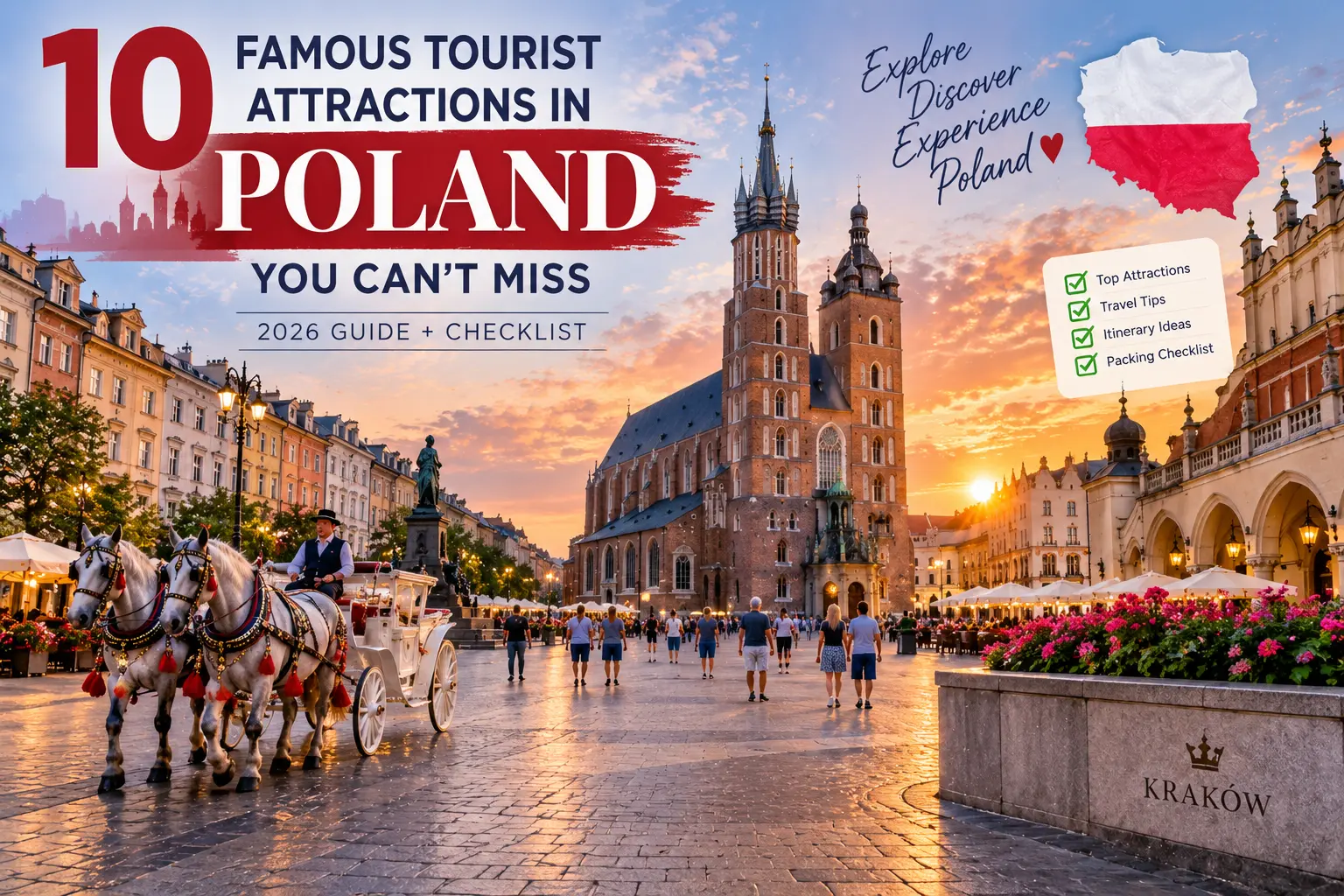

Poland is having a record tourism year. In 2025, an estimated 21.4 million foreign tourists visited Poland, up 8.5% from 2024, while accommodation establishments hosted 58.9 million tourists, an 11.6% increase. Warsaw, Kraków, and Gdańsk were among the country’s busiest destinations.
That growth matters when you are planning a trip.
Poland has far more famous sights than you can realistically fit into one holiday. Kraków alone can fill several days. Add Auschwitz, Wieliczka, Warsaw, Gdańsk, Wrocław, Zakopane, and the country’s castles and national parks, and the shortlist becomes difficult.
The problem is not finding places to visit. It is knowing which ones deserve your limited time, which require advance booking, and which can be comfortably added to an existing route.
Poor planning can cost you more than money. You can lose half a day travelling between cities, arrive at Auschwitz without a suitable entry slot, or reach a popular attraction at peak time and spend more time in a queue than inside.
I would plan Poland around the attractions first, then build the transport and accommodation around them.
This guide focuses on 10 famous Polish attractions that are practical for an international trip in 2026. For each one, I will cover when to go, how long to allow, booking requirements, typical costs where current figures can be confirmed, and whether the attraction is actually worth rearranging your itinerary for.
You will also get a comparison table, route-planning advice, a 10-day itinerary framework, and a printable checklist at the end.
One booking rule matters more than the others: book Auschwitz before you book your flight. Popular entry times can disappear well ahead of the travel date, particularly during the busiest periods.
Prices, opening hours, reservation rules, and transport schedules can change. I have treated 2025-2026 information as the current reference point, but you should still verify the official attraction or transport website immediately before travelling. Statistics Poland’s latest annual tourism publication was released in June 2026 and provides the current official baseline for national tourism figures.
The goal is simple: fewer tabs, fewer wasted hours, and a Poland itinerary that actually works.
The 10 Attractions at a Glance
Before booking hotels or building a day-by-day itinerary, use this table to see how the 10 attractions fit together. The key distinction is time versus travel: Kraków can cover several major sights from one base, while places such as Białowieża and Zakopane require more deliberate routing.
I have also checked the UNESCO status against UNESCO’s current Poland listing. Poland now has 18 properties inscribed on the World Heritage List, following the 2026 addition of Gdynia Modernist City Centre. (UNESCO World Heritage Centre)
| Attraction | City / Region | UNESCO Status | Best Time to Visit | Time to Allow |
|---|---|---|---|---|
| Kraków Old Town & Market Square | Kraków, Lesser Poland | UNESCO-listed | Spring or autumn for milder weather; early morning for fewer crowds | 3–5 hours |
| Wawel Castle | Kraków, Lesser Poland | UNESCO-listed as part of Historic Centre of Kraków | Spring or autumn; mornings are generally easier | 3–4 hours |
| Auschwitz-Birkenau Memorial | Oświęcim, near Kraków | UNESCO-listed | Early morning or weekdays; avoid peak periods where possible | At least 3 hours |
| Wieliczka Salt Mine | Wieliczka, near Kraków | UNESCO-listed | Early morning or later afternoon | 3–4 hours |
| Warsaw Old Town | Warsaw, Masovia | UNESCO-listed | Spring or autumn | 3–5 hours |
| Gdańsk Old Town | Gdańsk, Pomerania | Not currently UNESCO-listed | Late spring to early autumn; summer is busiest | Half to full day |
| Zakopane & Tatra Mountains | Zakopane, Lesser Poland | Tatra Mountains are not a UNESCO World Heritage property | Winter for skiing; summer for hiking | 1–2 days |
| Malbork Castle | Malbork, Pomerania | UNESCO-listed | Spring or autumn to avoid peak heat and crowds | 3–4 hours |
| Toruń Old Town | Toruń, Kuyavia-Pomerania | UNESCO-listed | Spring or autumn | 3–4 hours |
| Białowieża Forest | Podlaskie, near Belarus border | UNESCO-listed | Spring or autumn for comfortable walking | 1–2 days |
UNESCO confirms that Kraków’s Historic Centre, Auschwitz-Birkenau, Wieliczka and Bochnia Royal Salt Mines, Warsaw’s Historic Centre, Malbork, Toruń, and Białowieża Forest are among Poland’s World Heritage properties. (UNESCO World Heritage Centre)
How I would use this table
If this is your first Poland trip, Kraków should do the heavy lifting. You can combine the Old Town, Wawel Castle, Auschwitz-Birkenau, and Wieliczka Salt Mine without changing hotels every night.
Then add Warsaw.
After that, choose between the northern route through Gdańsk, Malbork, and Toruń, or the southern mountain route through Zakopane.
Białowieża is different. It is an excellent choice if you specifically want nature and European bison, but it is not something I would add casually to a short Kraków–Warsaw itinerary. UNESCO describes Białowieża as a transboundary World Heritage forest with exceptional biodiversity and one of Europe’s most important populations of free-roaming European bison. (UNESCO World Heritage Centre)
The same applies to Zakopane. It is worth your time if hiking or skiing is part of the trip. If your priority is Poland’s historic cities, use those extra days elsewhere.
One more correction worth making before publication: Gdańsk’s historic centre is not currently inscribed on UNESCO’s World Heritage List; Gdańsk-related heritage appears on UNESCO’s tentative list rather than the World Heritage List. (UNESCO World Heritage Centre)
1. Kraków Old Town & Market Square
Kraków’s Old Town is the easiest place on this list to explore without transport, and it gives you the quickest introduction to Poland’s history, architecture, food, and daily street life.
The historic centre is part of the UNESCO-listed Historic Centre of Kraków. At its heart is Rynek Główny, the enormous Main Market Square, with the Cloth Hall, St. Mary’s Basilica, and a dense network of historic streets leading toward Wawel Hill. UNESCO describes the historic centre as an exceptionally important European urban ensemble, with the medieval core, Wawel, and Kazimierz forming its main historic areas.
Why Kraków Old Town is famous
The appeal is not one individual monument. It is the concentration of them.
Walk across the Main Market Square and you can see the Cloth Hall (Sukiennice), St. Mary’s Basilica, historic townhouses, horse carriages, restaurants, cafés, and the towers of the old city. From here, streets such as Floriańska lead toward the former city gates, while Grodzka takes you south toward Wawel.
It is also one of the easiest attractions in Poland to combine with other major sights.
You do not need a car.
What to see
Give yourself enough time to explore rather than simply taking a photo in the square.
Key stops include:
- Rynek Główny, the Main Market Square
- Cloth Hall (Sukiennice)
- St. Mary’s Basilica
- St. Florian’s Gate
- Floriańska Street
- Grodzka Street
- Small museums and historic churches around the Old Town
- The route toward Wawel Hill
The Cloth Hall is worth seeing even if you are not interested in shopping. Its ground-level arcade is one of the square’s defining features, while the upper section houses the Sukiennice Gallery, part of the National Museum in Kraków.
How long do you need?
Allow 3–5 hours for the Old Town itself.
If you combine it with Wawel Castle and several museums, make it a full day.
I would not rush this section of Kraków. The distances are short, but the number of places worth stopping at adds up quickly.
When should you visit?
Go early if you want the square at its quietest.
Mornings are noticeably easier for photography and walking. By late morning and afternoon, tour groups and day visitors fill the main streets, particularly around the Cloth Hall and St. Mary’s Basilica.
Late afternoon is still useful if you prefer restaurants and street activity, but expect more people.
Is Kraków Old Town free?
Yes. Walking through the Old Town and Main Market Square is free.
You only pay for individual attractions, museums, exhibitions, church areas where admission applies, food, shopping, or guided tours.
That makes the Old Town one of the easiest places in Poland to explore on a budget.
My practical tip
Combine Kraków Old Town, Wawel Castle, and the Cloth Hall into one walking route.
They are close enough that moving between them is much easier than taking taxis or public transport.
I would start at the Main Market Square, explore the surrounding streets, continue south toward Wawel, and finish with a Vistula riverside walk if you still have energy.
For navigation, download an offline map before leaving your accommodation. The Old Town is easy to understand, but having the map available makes it simpler to find smaller museums, restaurants, and quieter streets away from the main tourist flow.
A quieter alternative nearby
If the Main Market Square feels too busy, do not assume you have to leave central Kraków.
Walk a few streets away from the busiest section and explore the smaller courtyards, churches, cafés, and streets around the historic centre. You can also continue toward Kazimierz, Kraków’s historic Jewish district, rather than spending the entire day around Rynek Główny.
This spreads your time across the city instead of concentrating it in one crowded square.
2025–2026 visitor statistics
Foreign tourist activity in Kraków County, 2025:
Kraków County ranked 2nd among Poland’s 380 counties for foreign tourist numbers, recording 1,635,953 foreign tourists and 3,979,877 overnight stays.
That figure applies to the wider county rather than the Main Market Square itself, so it should not be presented as an attraction-specific visitor count.
The numbers nevertheless show why you should expect crowds around Kraków’s main historic centre, particularly during the busiest travel periods.
Worth your time?
Yes, especially on a first trip to Poland.
Kraków Old Town earns its reputation because several major sights are concentrated within a compact, walkable area.
The trade-off is crowds.
If you dislike busy squares and organized tour groups, go early and spend more of your day exploring the side streets rather than standing in the centre of Rynek Główny.
2. Wawel Castle
Book the exhibitions you specifically want to see. Wawel Hill itself is easy to visit, but the castle’s individual exhibitions operate with their own tickets, schedules, and visitor limits.
Wawel Castle sits on a hill above the Vistula River and was the historic residence of Polish kings. Together with Wawel Cathedral and the surrounding historic complex, it forms one of the most important cultural sites in Kraków.
It is also part of the UNESCO-listed Historic Centre of Kraków.
Why Wawel Castle is famous
Wawel was the seat of Polish rulers for centuries.
The complex combines royal apartments, ceremonial rooms, religious buildings, courtyards, defensive structures, and collections connected with Poland’s political and cultural history.
For visitors, that means Wawel is not simply a castle where you walk around one building.
It is a large historic complex with several separate things to see.
What to see
Depending on your interests and available time, focus on:
- Wawel Royal Castle
- State Rooms
- Royal Private Apartments
- Wawel Cathedral
- Sigismund Bell
- Castle courtyards
- Defensive walls and viewpoints
- Vistula River views from the hill
The State Rooms are particularly useful if you want to understand how the royal residence functioned rather than simply seeing the exterior.
Wawel Cathedral is a separate highlight and should not be treated as just another room inside the castle.
How long do you need?
Allow around 3-4 hours if you want to visit several ticketed sections.
You can see the courtyards and exterior areas in less time, but that misses much of what makes Wawel worth visiting.
If you are interested in Polish history, give it the better part of a morning or afternoon.
Do you need a ticket?
Not for every part.
Wawel Hill and some exterior areas can be visited without buying a castle exhibition ticket. The State Rooms, Private Apartments, cathedral areas, and other exhibitions may require separate admission.
This is where planning matters.
Check the official Wawel Castle website for the exhibitions operating on your date, opening hours, admission prices, and ticket availability. Do not assume that one ticket automatically covers the entire complex.
When should you visit?
Spring and autumn are comfortable periods for exploring the hill and historic buildings.
During peak summer, arrive earlier if possible.
Popular exhibitions can become busy, and some ticketed sections have controlled capacity. If a particular exhibition is the reason you are visiting, book it ahead rather than relying on same-day availability.
Practical footwear matters
Wear comfortable shoes.
Wawel Hill involves slopes, stairs, courtyards, and uneven historic surfaces. This is not difficult for most visitors, but uncomfortable footwear becomes noticeable after several hours.
I would also avoid trying to combine every Wawel exhibition with a packed walking itinerary on the same day.
How to combine Wawel with Kraków Old Town
This is one of the easiest combinations in Poland.
Start at Rynek Główny, walk through the Old Town toward Grodzka Street, and continue south to Wawel Hill.
You can spend the morning around the Main Market Square and the afternoon at Wawel, or reverse the order if you want to reach the castle before the busiest period.
Afterwards, walk down toward the Vistula.
That gives you three different views of Kraków without repeatedly crossing the city.
A useful alternative after Wawel
If you have already spent hours inside museums and historic buildings, skip another indoor attraction.
Walk along the Vistula Boulevards instead.
The riverside route gives you a different perspective of Wawel Hill and is a simple way to slow down after the castle visit.
Is Wawel Castle worth it?
Yes, if Polish history interests you.
The exterior and hill are easy to see without spending much money, but I would pay for at least one major exhibition if you have never visited.
If your interest is mainly photography, you can spend less time inside and focus on the courtyards, cathedral, hill, and river views.
If you are travelling during peak season, however, do not leave your preferred exhibition until the last minute.
Wawel is worth your time, but you should decide what you actually want to see before buying tickets.
3. Auschwitz-Birkenau Memorial
Book Auschwitz before you book your flight. Entry to the Auschwitz-Birkenau Memorial is free, but visitors need a personalized entry pass for a specific date and time. The official memorial warns that reservations should be made through its official website, and guided visits have limited availability.
This is not a sightseeing stop to squeeze between lunch and dinner.
Auschwitz-Birkenau is the former Nazi German concentration and extermination camp complex near Oświęcim. It is now a museum and memorial documenting the crimes committed there, and the site is inscribed on the UNESCO World Heritage List.
Why Auschwitz-Birkenau is famous
Auschwitz has become one of the world’s most important places for understanding the Holocaust and the Nazi persecution and murder of millions of people.
The complex consists primarily of Auschwitz I and Auschwitz II-Birkenau.
Auschwitz I contains the former camp buildings and permanent exhibitions. Birkenau is the much larger second site, with the railway ramp, barracks, ruins, and memorial areas.
The experience is historical rather than recreational.
Plan accordingly.
What to see
The main visit includes:
- Auschwitz I
- Permanent historical exhibitions
- Original camp buildings and surviving structures
- Auschwitz II-Birkenau
- The railway ramp
- Former barracks and camp ruins
- The Birkenau memorial area
The two sites are close enough to visit as part of the same trip, but you should allow enough time rather than trying to rush through both.
How long do you need?
Allow at least three hours.
A guided visit can take longer depending on the route, group size, and current operating arrangements.
I would reserve a substantial part of the day rather than scheduling another major attraction immediately afterwards.
You also need travel time from Kraków. Oświęcim is roughly an hour and a half from Kraków by road under normal conditions, although actual journey times vary with traffic and transport choice.
Is entry free?
The memorial’s entry itself is free, but you need an entry pass.
This distinction catches some visitors out.
Do not treat the free admission as meaning you can simply arrive whenever you want. The official reservation system is the place to check available dates, entry arrangements, guided tours, and current visitor rules.
Book through the official memorial
Use the official Auschwitz-Birkenau Memorial reservation system:
Auschwitz-Birkenau official visitor reservation system
Avoid paying a reseller simply because you assume the memorial requires an expensive entrance ticket.
If you want a guided visit, check availability as early as possible. Official guided tours have limited places, and popular dates can fill well ahead of time.
When should you visit?
Early morning or weekdays can make the logistics easier, particularly outside the busiest summer period.
There is no “quiet” version of Auschwitz in the normal tourist sense. Visitor numbers remain significant, and the site operates with organized entry arrangements.
The bigger reason to choose your timing carefully is practical. A morning or early-day booking leaves more flexibility for transport and gives you enough time to visit both Auschwitz I and Birkenau without constantly watching the clock.
Dress and behaviour
Dress respectfully.
This is a memorial to victims of mass murder, not a normal tourist attraction. Keep conversations subdued, follow photography restrictions, and respect areas where photography or other activities are prohibited.
Comfortable shoes are sensible because you will walk between buildings and across the Birkenau grounds.
Weather can also change the experience significantly. Bring suitable layers and rain protection rather than assuming the visit will be entirely indoors.
My practical tip
Do not schedule Auschwitz immediately before a flight or important train connection.
Transport delays happen, and the visit itself deserves time.
If you are staying in Kraków, make Auschwitz a dedicated day or substantial half-day excursion. If you want historical context, a guided visit can be worthwhile because the buildings and ruins do not explain themselves.
The memorial’s official visitor information is the best source for current rules, tour arrangements, and restrictions.
A respectful way to add historical context
If you want to learn more about the region’s wartime history, consider researching other local memorials and museums after your Auschwitz visit rather than trying to turn the day into a packed sightseeing itinerary.
Keep the focus on learning.
Auschwitz itself provides more than enough material for one serious visit.
Is Auschwitz-Birkenau worth your time?
For travelers interested in European and 20th-century history, yes.
But “worth your time” here should not be confused with entertainment value.
This is a difficult historical site, and many visitors find the experience emotionally heavy. Give yourself some quiet time afterwards rather than immediately moving into another packed tourist schedule.
Book the entry first. Build the rest of your Kraków itinerary around it.
4. Wieliczka Salt Mine
Book ahead if your Kraków itinerary is tight. The Wieliczka Salt Mine is one of the easiest major day trips from Kraków, but the underground tour follows a fixed route and timetable, so arriving without a plan can waste valuable time.
The mine has been worked for centuries and is now one of Poland’s most visited heritage attractions. It is also part of the Wieliczka and Bochnia Royal Salt Mines UNESCO World Heritage property.
Unlike Auschwitz, Wieliczka is a conventional visitor attraction.
You can enjoy it as a fascinating piece of engineering, mining history, architecture, and underground art.
Why Wieliczka is famous
Salt mining shaped Wieliczka for centuries.
The attraction is famous for its underground chambers, corridors, sculptures, saline lakes, and especially the Chapel of St. Kinga, where much of the decoration was carved from salt by miners.
The scale is what makes the visit interesting.
You descend below ground and follow a structured tourist route through sections of the historic mine.
What to see
The main Tourist Route includes:
- Historic underground chambers
- Salt sculptures
- Underground lakes
- Mining equipment and infrastructure
- Historic chapels
- St. Kinga’s Chapel
- Long sections of underground corridors
The chapel is the section most visitors remember, but I would not plan the entire visit around one room. The route works because it shows how the mine developed and how miners actually worked underground.
How long do you need?
Allow approximately 3–4 hours for the standard Tourist Route, including the practical time required to arrive, enter, and complete the route.
If you choose a different route or a specialist tour, allow additional time.
This is important when combining Wieliczka with another Kraków attraction.
Do not book a mine tour at 9:00 a.m. and expect to be back in central Kraków for a tightly scheduled 12:00 appointment.
Leave some margin.
Should you book tickets in advance?
Yes, particularly during busy periods.
The official Wieliczka Salt Mine ticket system provides current tour options, dates, and prices. Use it to check the exact route available on your travel date.
Wieliczka Salt Mine official website and ticket information
Tickets may also be available on site, but advance booking is the safer choice when your Kraków schedule is fixed.
What should you wear?
Wear comfortable shoes and layers.
The underground environment stays considerably cooler than the surface, even during summer. You will also be walking for several hours.
You do not need specialist hiking equipment for the standard Tourist Route, but comfortable footwear makes a noticeable difference.
When should you visit?
Early morning is a good choice if you want to get ahead of larger tour groups.
Late afternoon can also work.
The important point is to avoid creating a timetable that depends on the mine running exactly to your preferred schedule. Group tours and underground routes operate within fixed arrangements, so build some flexibility into your day.
My practical tip
If you are staying in Kraków for several days, do not automatically combine Wieliczka with Auschwitz.
Both are popular day trips, but they are completely different experiences and each deserves attention.
Auschwitz requires historical focus and emotional space. Wieliczka is an underground heritage attraction involving several hours of walking.
Putting both into one exhausting day may save accommodation time, but it does not necessarily create a better trip.
If your schedule allows, give each its own half-day.
Getting there from Kraków
Wieliczka is close enough to Kraków to make a straightforward half-day excursion.
You can use public transport, rail, taxi, or an organized tour from Kraków. If you choose a guided day trip, compare exactly what is included before paying: transport, entry, guide, and return transfer are not necessarily included in every package.
For independent travelers, official attraction information should be your first reference for entry times and current visitor arrangements.
A quieter alternative nearby
After the mine, resist the temptation to immediately add another major attraction.
Wieliczka itself has a historic town centre, and you can use the remaining time for a slower meal or short walk before returning to Kraków.
That is a better use of the afternoon than trying to squeeze in another ticketed attraction simply because you have a few hours left.
Is Wieliczka Salt Mine worth your time?
Yes, particularly if you have at least three days in the Kraków area.
The mine offers something Kraków’s castles and churches cannot: a large underground industrial heritage site with rooms and chapels carved into salt.
It is also easy to reach compared with many other Polish attractions.
If your trip is extremely short and you have to choose between several Kraków-area attractions, prioritize based on your interests. History-focused travelers may give Auschwitz more time, while visitors who want architecture and unusual engineering will find Wieliczka a strong addition.
5. Warsaw Old Town
Use the train. If Warsaw is your next major stop after Kraków, I would take PKP Intercity rather than rent a car. The train connection is practical, and having a car in central Warsaw creates more parking and traffic problems than it solves.
Warsaw’s Old Town is one of Poland’s most unusual historic attractions because much of what you see today was painstakingly reconstructed after the Second World War. UNESCO inscribed the Historic Centre of Warsaw in 1980, specifically recognizing the exceptional reconstruction of the historic centre after its near-total destruction.
Why Warsaw Old Town is famous
The story is as important as the architecture.
After World War II, Warsaw’s historic centre was devastated. The Old Town was subsequently reconstructed using surviving documentation, paintings, photographs, and architectural records.
Today, you can walk through Castle Square, see the Royal Castle, continue into the Old Town Market Square, and follow sections of the old defensive walls.
It looks historic because the reconstruction was deliberately faithful.
What to see
Allow time for:
- Castle Square
- Royal Castle
- Old Town Market Square
- Warsaw Mermaid statue
- City walls and Barbican
- St. John’s Cathedral
- Historic streets around the Old Town
The Royal Castle is the major paid attraction. If you are interested in Polish royal history, it is worth adding to the walking route.
How long do you need?
Allow 3–5 hours for the Old Town and its main sights.
A quick walk through the square can take much less time, but that misses the reconstruction story and several smaller streets and buildings.
If you include the Royal Castle and museums, plan most of a day.
When should you visit?
Spring and autumn are the easiest seasons for walking.
Summer gives you longer days and more outdoor activity, but also more visitors.
Early morning is useful if you want photographs without large groups. Late afternoon works well if you want to continue toward the Vistula afterwards.
Is Warsaw Old Town free?
Walking through the Old Town is free.
You pay separately for attractions such as the Royal Castle and museums.
That makes the historic centre easy to explore even on a limited budget.
My practical tip
Use Warsaw Old Town as the starting point, not the entire Warsaw itinerary.
After exploring the reconstructed centre, walk toward the Vistula riverfront or continue into a modern part of the city.
That contrast is important.
Warsaw is much more than its reconstructed historic core. The modern skyline, parks, cafés, museums, and riverside areas show how different the city is from Kraków.
Getting from Kraków to Warsaw
PKP Intercity is the main long-distance rail operator and is the option I would use for this route.
Check current schedules and fares through the official railway booking system before travelling. PKP Intercity
For other regional connections, Polregio is another useful rail operator. Polregio
Book ahead when travelling around major holidays or weekends.
Is Warsaw Old Town worth your time?
Yes, particularly if you want to understand modern Polish history.
The reconstruction is the reason I would not treat Warsaw as simply another pretty European old town.
The important question is not whether every building is centuries old. It is how the city reconstructed a historic centre that had been almost completely destroyed.
That story gives Warsaw an identity Kraków does not have.
6. Gdańsk Old Town
Give Gdańsk at least half a day, and stay overnight if you can. The Baltic setting changes the feel of a Poland itinerary, and the city works particularly well after Warsaw or as part of a northern Poland route.
Gdańsk’s historic centre is known for its Hanseatic architecture, maritime history, amber trade, and waterfront. It is not currently a UNESCO World Heritage Site, so do not confuse its historical importance with UNESCO status.
Why Gdańsk is famous
Gdańsk was one of the major ports of the Baltic and an important centre of trade.
Its most recognizable streets are concentrated around the historic centre, where you will find decorated townhouses, the Long Market, Neptune Fountain, St. Mary’s Church, and the Motława waterfront.
The city also has a strong connection to amber.
You will see amber shops throughout the central tourist area.
What to see
Start around:
- Long Street (Długi Street)
- Long Market (Długi Targ)
- Neptune Fountain
- St. Mary’s Church
- The historic waterfront
- Medieval Crane
- Amber shops
- Motława River
The Crane (Żuraw) is particularly useful for understanding Gdańsk’s maritime history.
How long do you need?
Allow half a day for the central historic area.
I prefer a full day or overnight stay.
That gives you time to explore the main streets without rushing and then add a museum, waterfront walk, or another part of the city.
When should you visit?
Summer offers the best combination of longer daylight, coastal weather, and outdoor activity.
It is also when Gdańsk gets busiest.
Expect higher accommodation prices and more people around the main streets in July and August.
If you want a quieter visit, consider late spring or early autumn.
Is Gdańsk Old Town free?
Yes.
Walking through the historic centre is free.
Museums, church towers, and other attractions charge their own admission.
Check current opening hours before building a tight schedule because individual attractions do not necessarily follow the same timetable.
My practical tip
Do not spend your entire Gdańsk visit on the busiest tourist street.
Walk along the Motława, explore side streets, and give yourself time to look beyond the amber shops and souvenir stores.
If you have another day, consider adding a coastal stop or nearby attraction rather than simply repeating the same central walking route.
How to reach Gdańsk
Gdańsk fits naturally into a rail itinerary with Warsaw.
This is another route where I would avoid renting a car unless you are deliberately exploring rural northern Poland.
Use PKP Intercity for long-distance travel and check the timetable before booking accommodation around a specific train.
Is Gdańsk worth your time?
Yes, especially if you want a coastal city with a different character from Kraków and Warsaw.
The trade-off is distance.
If you only have five days in Poland, I would not add Gdańsk just to tick another famous city off the list. If you have a week or more, it becomes much easier to justify.
7. Zakopane & the Tatra Mountains
Choose Zakopane based on the season and your interests. If you hike or ski, give it serious time. If your Poland trip is mainly historic cities, do not force it into a short itinerary.
Zakopane sits at the foot of the Tatra Mountains and is one of Poland’s main mountain resorts. It is the gateway to Tatra National Park, with hiking trails, mountain viewpoints, cable cars, traditional highland architecture, and thermal baths.
The Tatra Mountains are not currently a UNESCO World Heritage property, so this attraction belongs on the list for its landscape, outdoor activities, and cultural character rather than UNESCO status.
Why Zakopane is famous
Zakopane has long been associated with Polish mountain culture.
The town’s most tourist-heavy street is Krupówki, where restaurants, shops, and souvenir stalls concentrate.
But the real reason to travel here is outside the centre.
The mountains are the attraction.
Popular options include:
- Morskie Oko
- Kasprowy Wierch
- Gubałówka Hill
- Tatra National Park hiking trails
- Highland-style architecture
- Thermal baths
- Winter skiing
How long do you need?
Allow at least one full day.
Two days is better if hiking is a priority.
A day trip from Kraków is possible, but it creates a long day, particularly if you want to hike. If you are serious about seeing the mountains rather than simply photographing Zakopane’s main street, stay overnight.
When should you visit?
The answer depends entirely on what you want to do.
Winter: skiing, snow, and mountain resort atmosphere.
Summer: hiking and longer daylight.
Spring and autumn can be quieter, but trail and weather conditions can be less predictable.
Always check current trail conditions before heading into the mountains.
Book cable cars ahead
If you want to use the cable car to Kasprowy Wierch, check the official operator’s current ticket arrangements and book ahead during busy periods.
Queues can become frustrating in peak season.
The same principle applies to accommodation. Winter weekends and major holiday periods can fill quickly.
My practical tip
Do not judge Zakopane by Krupówki Street alone.
It is busy.
If you want the mountain experience, move beyond the central shopping area and spend your time on the trails, viewpoints, or in the surrounding villages.
For hiking, start early.
Popular trails can become crowded, especially during summer weekends and good-weather periods.
Morskie Oko
Morskie Oko is one of the best-known mountain destinations in Poland and therefore one of the busiest.
It is worth seeing if you enjoy hiking and mountain scenery, but do not expect solitude.
Go early if you want a more manageable experience.
Wear proper footwear and check the weather before leaving. Mountain conditions can change quickly even when Zakopane itself feels comfortable.
Thermal baths
Thermal pools are a useful alternative if weather disrupts your hiking plans.
They also work well for families or travelers who want a slower day after a long mountain walk.
Check individual facilities for current opening hours, prices, and reservation requirements.
Is Zakopane worth your time?
Yes for hikers, skiers, and travelers who want a nature break.
For a first-time city-focused Poland itinerary, I would not sacrifice an extra day in Kraków or Warsaw simply to squeeze Zakopane in.
But if mountains are part of why you chose Poland, give Zakopane enough time to do them properly.
The mistake is not visiting Zakopane. The mistake is travelling there for one rushed afternoon and thinking you have seen the Tatras.
8. Malbork Castle
Malbork is worth the detour if you like medieval history or are already traveling between Gdansk and Warsaw. The scale is the point. This is not a castle you can rush through in 45 minutes.
What it is
Malbork Castle is the enormous brick fortress built by the Teutonic Knights and one of Poland’s UNESCO World Heritage sites. Its complex includes the High Castle, Middle Castle, Grand Master’s Palace, defensive walls, courtyards, and a museum collection.
Why it’s famous
It is one of the defining medieval fortresses in northern Europe. The architecture is impressive, but the size can catch first-time visitors off guard. Give yourself enough time to walk between the different sections rather than treating it as a quick photo stop.
Key highlights
- High Castle and its courtyards
- Middle Castle
- Grand Master’s Palace
- Castle museum
- Medieval defensive walls and towers
- Views toward the Nogat River
Practical visitor information
Malbork is an easy day trip from Gdansk by train. PKP Intercity and Polregio services connect the two cities, making a rental car unnecessary for most travelers.
Tickets are available online and at the castle, but I would book ahead during the summer and other busy periods. Opening hours and access to individual sections can change seasonally, so verify the current schedule before traveling.
Allow at least 3–4 hours if you want to see the main sections without rushing.
Worth your time?
Yes, particularly if you are already in Gdansk.
I would not make a long cross-country detour solely for Malbork unless medieval architecture is a major reason for your trip. For a Gdansk-based itinerary, however, it is one of the easiest worthwhile day trips.
Expert tip
Check the castle’s seasonal opening hours before you go. Some sections and visitor services operate on reduced schedules outside the main season.
For transport, check PKP Intercity or Polregio, then use the official Malbork Castle website for current tickets and visitor information.
9. Torun Old Town
Torun works particularly well as a stop between Warsaw and Gdansk. It is compact, historic, and easier to cover in a day than Krakow’s larger historic center.
What it is
Torun is a Gothic medieval city on the Vistula River and the birthplace of Nicolaus Copernicus. Its historic center is a UNESCO World Heritage site, with a remarkably intact medieval street layout and architecture.
Why it’s famous
The city combines three things travelers can easily experience in one visit: medieval architecture, Copernicus history, and Poland’s long gingerbread tradition.
The Old Town itself is the attraction. You do not need to build a complicated sightseeing schedule.
Key highlights
- Old Town Market Square
- Medieval Town Hall
- Copernicus House
- Gothic churches
- Vistula riverside
- Gingerbread museum and workshops
Practical visitor information
Walking through the Old Town is free. Museums and interactive attractions charge admission, so check their current prices before visiting.
Torun is connected by rail with Warsaw and Gdansk, making it a practical stop without a car. PKP Intercity is the main long-distance rail operator to check for schedules and tickets.
Allow one full day for the historic center. An overnight stay makes sense if you want a slower evening and morning before continuing your route.
Worth your time?
Yes, especially if you are already traveling between Warsaw and Gdansk.
Torun is less demanding than Krakow. You can walk the central area, visit one or two museums, try the local gingerbread, and still have time to sit by the river.
Expert tip
Do not spend the entire visit around the busiest part of the Market Square. Walk toward the river and explore some of the smaller streets once the main sightseeing circuit gets crowded.
Check Poland Travel for current destination information and the official Torun tourism website for events and practical details.
Try the gingerbread properly
A gingerbread workshop is more useful than simply buying a packaged souvenir. You get some context about the city’s baking tradition and a hands-on activity without adding several hours to the itinerary.
10. Bialowieza Forest
Bialowieza is the choice for travelers who want Poland to feel very different from Krakow, Warsaw, or Gdansk. It is not a quick sightseeing stop. Plan it as a nature-focused trip.
What it is
Bialowieza Forest is one of Europe’s remaining large areas of primeval forest and a UNESCO World Heritage site. It extends across the Poland-Belarus border and is particularly associated with the European bison.
Why it’s famous
The forest provides a completely different experience from Poland’s historic cities. Instead of moving between castles, churches, and market squares, you spend time among ancient woodland, wildlife habitats, and protected areas.
The European bison is the headline attraction, but the forest itself is the reason to come.
Key highlights
- European bison
- Bialowieza village
- Forest trails
- Cycling routes
- The Strict Reserve
- Guided walks through protected areas
Practical visitor information
Access rules vary across different parts of the forest. The Strict Reserve has controlled access and requires a licensed guide.
Do not assume you can simply walk into every section of the forest independently.
Check current regulations, trail conditions, access restrictions, and guide requirements before setting out. Seasonal conditions can also affect what is accessible.
Allow at least one full day, although two nights gives you considerably more flexibility for guided walks and wildlife viewing.
Worth your time?
Yes, if nature is a priority.
I would skip Bialowieza on a short first trip focused on Poland’s major cities. The travel time is harder to justify when you have only seven or eight days. With 10–14 days, it becomes a much more realistic addition.
Expert tip
Book a licensed guide if you want to enter the Strict Reserve. The rules are there to protect the forest, and a guide also adds useful context that you would miss on an ordinary walk.
Check Poland Travel and official park information before traveling because access conditions can change.
Look beyond the bison
Do not structure the entire visit around finding a bison. Wildlife sightings are never guaranteed. Give yourself time to experience the forest itself, and consider cycling or a guided woodland walk if conditions allow.
Practical Planning Information: Tickets, Reservations and Getting Around
Poland is relatively easy to travel around once you organize the route correctly. The bigger problem is booking the attractions that have limited capacity. Do those first, then build your transport and accommodation around them.
Booking Tickets and Reservations
Book Auschwitz before you book your flight. Free timed-entry slots can disappear weeks ahead during busy periods, while guided tours fill even faster.
- Auschwitz-Birkenau: Entry is free, but timed slots are required. Use the official reservation system and allow at least three hours for the visit. Guided tours are limited, so book ahead.
- Wieliczka Salt Mine: Reserve your tour through the official ticket portal. Early morning or late afternoon usually makes more sense than arriving with the largest tour groups.
- Wawel Castle: Check the official website for current exhibition schedules, ticket prices, and advance-booking requirements. Popular interiors can become busy during peak season.
- Zakopane and Tatra Mountains: Book accommodation and popular cable-car tickets early during winter and other peak periods. Check trail conditions before heading into the mountains.
- Malbork Castle: Check the current opening schedule and ticket options before traveling, particularly outside the main summer season.
- Torun museums: The Old Town is free to explore, but museums and specialist attractions require separate tickets.
Use official attraction websites whenever possible. Third-party platforms can be convenient for guided excursions, but compare what is included before paying more for the same basic admission.
For guided day trips, platforms such as GetYourGuide and Viator can simplify transport and tour arrangements. I would still check the attraction’s official rules first.
Getting Between Attractions
Use the trains for the main city-to-city route.
Poland’s rail network makes a car unnecessary for most first-time itineraries. PKP Intercity handles many long-distance journeys, while Polregio serves numerous regional routes.
A practical rail itinerary can connect:
- Krakow → Warsaw
- Warsaw → Gdansk
- Gdansk → Malbork
- Gdansk → Torun
- Warsaw → Torun
- Krakow → Wieliczka and surrounding destinations
Check PKP Intercity and Polregio for current schedules and fares.
I would not rent a car simply to move between Poland’s major cities. Trains save you the hassle of parking, city traffic, and returning a vehicle to another location.
A car becomes more useful when your itinerary moves into rural areas. Bialowieza and some parts of the Tatra region are easier with a vehicle, although buses and organized transfers can also work.
Getting Around Within Cities
Krakow, Warsaw, Gdansk, and Torun are easy to explore without a car.
The historic centers are compact, and walking is usually faster than dealing with traffic and parking.
Use trams and buses for longer distances. Check the current local ticket system before traveling because validation rules and ticket options vary between cities.
For mountain destinations and rural areas, check the latest bus schedules rather than assuming services run frequently throughout the day.
My Transport Rule for a First Poland Trip
Keep the itinerary simple:
Train between major cities. Walk inside historic centers. Use local buses or taxis for the awkward connections. Rent a car only when it genuinely saves time.
Download offline Google Maps before leaving your accommodation. It is particularly useful in historic districts, where narrow streets and pedestrian zones can make the fastest route less obvious.
A local SIM or eSIM is also useful for checking train platforms, attraction opening hours, maps, and last-minute booking changes while traveling.
Best Time to Visit and Seasonal Considerations
There is no single best month for all 10 attractions. Choose the season around your route. Krakow and Warsaw work well in the shoulder seasons, the Baltic coast is strongest in summer, and Zakopane makes more sense in winter if skiing is part of the plan.
Spring and Autumn Shoulder Seasons
Spring and autumn are my preferred seasons for a city-focused Poland trip. Temperatures are generally easier for walking, major attractions are less pressured than during the summer peak, and accommodation can be more reasonable.
These seasons work particularly well for:
- Krakow Old Town and Wawel Castle
- Auschwitz-Birkenau
- Wieliczka Salt Mine
- Warsaw Old Town
- Gdansk
- Torun
- Malbork Castle
- Bialowieza Forest
For outdoor attractions, check current trail and access conditions before traveling. This matters particularly in the Tatra Mountains and Bialowieza.
Do not assume every museum or historic site keeps identical hours throughout the year. Check official opening schedules before setting out, especially in the shoulder and winter seasons.
Summer Peak Season
Summer gives you the longest days, but you pay for them with crowds.
Gdansk is particularly appealing in summer because of the Baltic coastline, outdoor dining, and easier access to coastal activities. The trade-off is higher accommodation demand and busier streets around the Long Market and waterfront.
Krakow, Auschwitz, Wieliczka, and Zakopane can also become crowded.
Go early.
That matters more than trying to squeeze another attraction into the same day. Starting early gives you quieter streets, shorter queues, and more flexibility when an attraction takes longer than expected.
If you are visiting Gdansk in July or August, book accommodation and popular attractions ahead rather than assuming you can arrange everything after arrival.
Winter Travel and Seasonal Closures
Choose winter deliberately. It is excellent for skiing and mountain scenery but less convenient for a sightseeing-heavy itinerary.
Zakopane becomes Poland’s major winter resort, so accommodation, cable cars, and popular activities can fill quickly. Check Tatra National Park conditions before hiking, particularly when snow and ice are present.
Winter can also mean shorter opening hours at some historic attractions. Check the official schedule rather than relying on opening times from an older travel article.
The Wieliczka Salt Mine is a useful winter attraction because the underground route operates separately from outdoor weather. Temperatures underground remain cool throughout the year, so wear layers and comfortable shoes.
For Auschwitz-Birkenau, winter weather can make the outdoor Birkenau section colder and more demanding. Allow enough time and dress accordingly.
If your priority is Poland’s historic cities, choose spring or autumn. If you want skiing and snow, choose winter. If you want the Baltic coast and long daylight hours, choose summer.
Suggested 10-Day Itinerary Connecting the 10 Attractions
This itinerary works, but I would make one important adjustment: do not treat all 10 attractions as equal stops. Bialowieza and Zakopane require more travel time than the city sights, so trying to squeeze everything into exactly 10 days will make the final part of the trip rushed.
For a first visit, follow the route below and treat Bialowieza as the optional final addition.
Days 1–3: Krakow Base
Day 1: Krakow Old Town + Wawel Castle
Start early in Krakow’s Old Town. Walk through the Main Market Square, see the Cloth Hall and St. Mary’s Basilica, then continue toward Wawel Hill.
Spend the afternoon exploring Wawel Castle and its grounds.
These attractions are close enough to combine without wasting time on transport.
Day 2: Auschwitz-Birkenau
Book your timed entry before planning the rest of the trip.
Allow at least three hours at the memorial, plus transportation time from Krakow. A guided visit can take longer.
Keep the rest of the day light. This is not a sightseeing stop I would combine with another major attraction.
Day 3: Wieliczka Salt Mine
Take the morning or late-afternoon tour of the Wieliczka Salt Mine. The underground route takes several hours, so do not schedule another major attraction immediately afterward.
If you finish early, use the remaining time for a smaller local stop rather than rushing back into Krakow’s busiest areas.
Day 4: Krakow → Warsaw
Take a train to Warsaw using PKP Intercity.
Once you arrive, explore Warsaw Old Town, Castle Square, the Old Town Market Square, and the Royal Castle if your timing allows.
This is deliberately a lighter day. The train journey and hotel check-in take part of it.
Day 5: Warsaw → Torun
Travel north by train to Torun.
Spend the afternoon walking through the Old Town, visiting the Town Hall or Copernicus-related attractions, and trying traditional Torun gingerbread.
Stay overnight if you prefer a slower pace.
If you are trying to save time, continue toward Gdansk after exploring the historic center.
Day 6: Gdansk
Use the day for Gdansk’s historic center.
Start around the Long Market, then walk toward the Motlawa waterfront and the medieval crane. Add St. Mary’s Church and an amber shop if they interest you.
Summer is the busiest period, so start early.
Day 7: Malbork Castle Day Trip
Take the train from Gdansk to Malbork.
Allow at least three to four hours for the castle. The complex is much larger than it looks in photographs.
Return to Gdansk in the evening.
This is one of the easiest day trips on the itinerary because you do not need to change hotels.
Days 8–9: Zakopane & Tatra Mountains
This is where the itinerary becomes more demanding.
Travel south toward Zakopane. Depending on your transport and starting point, the journey can take a substantial part of the day.
Day 8: Travel to Zakopane, settle in, then explore Krupowki Street or visit a thermal bath.
Day 9: Dedicate the day to the Tatra Mountains. Choose your trail according to weather, fitness, and current trail conditions. If you plan to use a cable car, book it ahead during busy periods.
Do not underestimate mountain travel times. A trail that looks short on a map can take most of the day.
Day 10: Bialowieza Forest or Departure
Bialowieza is the difficult addition.
If seeing the forest is a priority, use Day 10 only if your transport and departure plans make the connection realistic. Otherwise, I would skip Bialowieza rather than turn the final day into a race between trains and buses.
If you have additional time, give Bialowieza at least one full day and preferably an overnight stay. The forest deserves more than a few hours squeezed between other destinations.
The Smarter 10-Day Version
If you have exactly 10 days, my practical priority would be:
Krakow → Auschwitz → Wieliczka → Warsaw → Torun → Gdansk → Malbork → Zakopane
Then choose either Bialowieza or additional time in the Tatra Mountains, rather than forcing both into the itinerary.
Use trains for the major Krakow–Warsaw–Torun–Gdansk connections. For Zakopane and Bialowieza, compare buses, private transfers, and car rental based on your exact dates.
Check current schedules before booking accommodation around the route. Seasonal changes, engineering works, and attraction opening hours can alter the most efficient order.
What I Would Skip on a Short Trip
If you only have five days, do not attempt all 10.
Choose Kraków and its surrounding attractions.
A sensible five-day structure is:
- Kraków Old Town
- Wawel Castle
- Auschwitz-Birkenau
- Wieliczka Salt Mine
- One flexible Kraków day
If you have seven days, add Warsaw.
If you have 10–12 days, add Gdańsk and Malbork.
If you have two weeks or more, then consider Zakopane, Toruń and Białowieża.
This approach saves you from spending your holiday watching Poland through a train window.
Budget Tips for Poland
Poland remains relatively good value, but famous attractions still add up.
Save money by:
- Walking Old Towns instead of buying sightseeing packages.
- Booking trains in advance where cheaper fares are available.
- Using official attraction websites.
- Staying slightly outside the busiest historic center.
- Eating one main meal away from tourist squares.
- Using free city parks and viewpoints.
- Combining attractions geographically instead of crossing a city repeatedly.
Carry some Polish złoty for smaller vendors, markets and incidental expenses, although cards are widely accepted in major cities.
How to Avoid the Biggest Crowds
The rule is simple.
Start earlier than the tour groups.
For Kraków, get to the Main Market Square in the morning.
For Wieliczka, use an early or later slot.
For Auschwitz, choose the time that fits the official schedule and allow enough time for the full visit rather than trying to squeeze it between other attractions.
For Gdańsk, walk the main streets early and return later.
For Zakopane, start mountain activities early.
And for Malbork, check the day’s official route and entry time before traveling from Gdańsk.
Printable Poland Attractions Checklist
Use this before and during your trip.
Main Attractions
- Kraków Old Town & Market Square
- Wawel Castle
- Auschwitz-Birkenau Memorial – book entry in advance
- Wieliczka Salt Mine – book ticket
- Warsaw Old Town
- Gdańsk Old Town
- Zakopane & Tatra Mountains
- Malbork Castle
- Toruń Old Town
- Białowieża Forest – arrange licensed guide if entering the Strict Protection Area
Before You Leave
- Check passport and entry requirements
- Book accommodation
- Reserve Auschwitz
- Reserve Wieliczka
- Check Wawel exhibitions
- Check Malbork opening hours
- Book Zakopane accommodation in peak season
- Check Tatra trail conditions
- Check Białowieża access rules
- Download offline maps
- Download train booking apps
- Carry some Polish złoty
- Keep digital copies of important travel documents
Final Recommendation: Build the Route, Not the Bucket List
Poland rewards travelers who group attractions properly.
Start with Kraków. The Old Town, Wawel, Auschwitz and Wieliczka can form the core of a southern itinerary without wasting days on unnecessary transfers.
Then move north to Warsaw, Toruń and Gdańsk.
Add Malbork from Gdańsk.
Treat Zakopane as a mountain extension rather than another box to tick.
Treat Białowieża as a separate nature-focused trip unless you have enough time.
The most important bookings come first: Auschwitz and Wieliczka. Wawel exhibitions and popular Zakopane activities should follow during busy periods.
Poland’s tourism numbers are growing, with 21.4 million foreign tourists recorded in 2025 and major cities seeing millions of visitors. That makes early planning more useful than it was a few years ago.
And remember the basic rule:
Do not try to see all of Poland just because the map makes the distances look manageable.
Give each region enough time to enjoy it.
For 2026, verify prices, opening hours, train schedules, trail conditions and reservation rules immediately before travel. Attraction schedules change, and official sources should take priority over old travel blogs.
Poland Travel – official tourism information
UNESCO World Heritage – Poland
Auschwitz-Birkenau Memorial – official visitor information
Wieliczka Salt Mine – official tickets
Wawel Royal Castle – official visitor information
Malbork Castle Museum – official visitor information
Białowieża National Park – official visitor information
Last updated: September 23, 2026. Practical information should be rechecked before booking.