

Norway is easy to fall in love with and surprisingly difficult to plan. The country stretches roughly 1,700 km from south to north, yet many of the places you see in travel photos sit far apart across fjords, islands, mountain roads, and Arctic towns.
That distance changes everything.
I have planned multiple trips through Norway, and the mistake I see most often is treating the country like a compact sightseeing circuit. It is not. A place that looks close on a map can take half a day by car, train, bus, or ferry. Miss one ferry connection in the fjords, and your carefully planned afternoon can disappear.
Norway is also getting busier. Statistics Norway recorded 40.6 million guest nights at commercial accommodation establishments in 2025, up 5.2% from 2024. Foreign visitors accounted for 14.2 million of those nights, a 14% increase year over year. SSB
That matters when planning popular places such as Geirangerfjord, Tromsø, and Lofoten.
Most lists stop at the names. They tell you what looks good. They rarely tell you when to go, how to get there, how many nights to allow, or whether the detour is actually worth it.
That is how first-time visitors end up spending hours in transit, paying peak-season prices, and rushing through places they could have enjoyed with one extra night.
I prefer a different approach.
This guide focuses on the 10 Norway attractions that are genuinely worth building a trip around. I will explain the practical route to each one, realistic travel times, the best season, what to skip when your itinerary is tight, and which destinations work well together.
There is some good news on the budget side, too. Norway is still expensive, but the Norwegian krone remains relatively weak against several major currencies. Visit Norway’s 2026 figures put the average hotel room at around NOK 1,725 per night, while basic campsite cabins can start around NOK 700. Visit Norway
So 2026 can offer better value than many travelers expect, particularly if you avoid the busiest weeks and book strategically.
The key is not trying to see all of Norway.
It is choosing the right parts of Norway for the amount of time you actually have.
By the end of this guide, you will know which attractions to prioritize, when to visit, how to reach them without a car, how to combine them into a realistic route, and where to cut the itinerary when time or money runs short.
The 10 Best Places to Visit in Norway (Ranked)
1. Geirangerfjord – The Iconic Fjord
Best time: Late May to June and September
Geirangerfjord is worth the detour, but timing matters. This UNESCO-listed fjord is the Norway you have probably already seen in photographs: steep mountains dropping into dark blue water, waterfalls cutting through the cliffs, and viewpoints high above the valley. UNESCO lists the Geirangerfjord area as part of the West Norwegian Fjords World Heritage property, recognized for its exceptional natural landscape.
The catch is its popularity.
Visit in July or August and you can spend much of your time sharing the experience with cruise passengers. Go in late May, June, or September instead, and the same viewpoints feel considerably easier to enjoy.
What makes Geirangerfjord worth visiting?
The fjord itself is the main attraction. Do not limit your visit to the village of Geiranger.
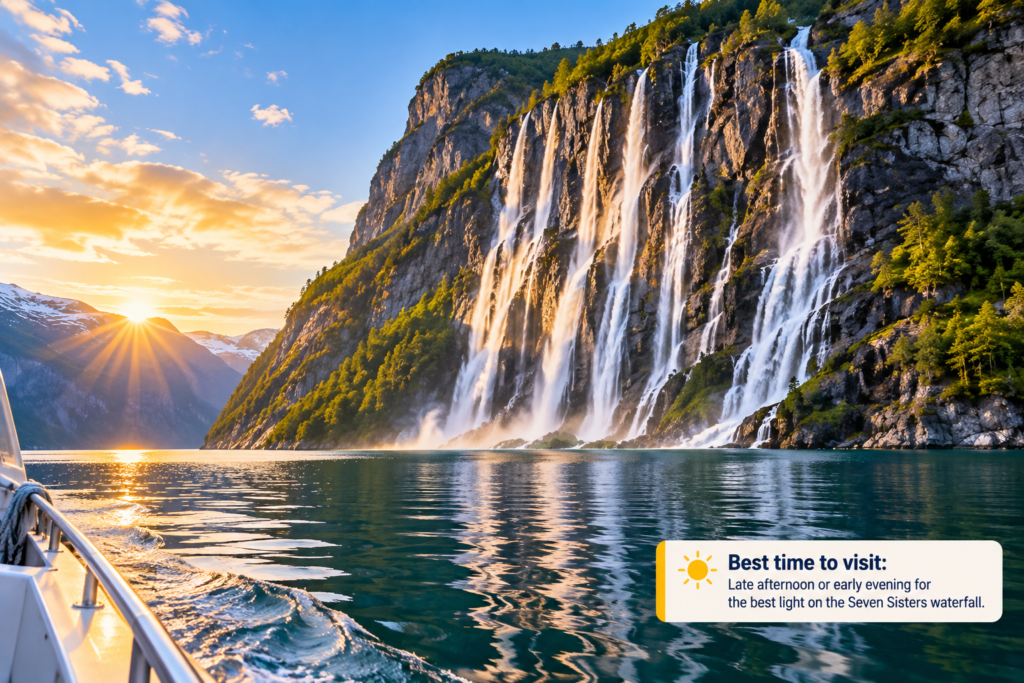
The Seven Sisters waterfall is the signature sight. The seven separate streams drop down the mountainside opposite the abandoned Knivsfla farm. The Bridal Veil is another waterfall visible from the water.
I recommend seeing the fjord from two perspectives: from the water and from above.
A boat trip gives you the scale of the cliffs and waterfalls. The road viewpoints show you why Geirangerfjord has become one of Norway’s defining landscapes.
The most useful viewpoints include:
- Ørnesvingen (Eagle’s Bend): One of the easiest dramatic viewpoints to reach by road. You look down toward Geiranger and the fjord.
- Dalsnibba: A much higher viewpoint reached from the Geiranger area when the road is open. Weather can change quickly at this altitude.
- Flydalsjuvet: A classic roadside viewpoint close to Geiranger with a broad view over the village and fjord.
If you have a rental car, these viewpoints make the area much easier to explore.
How to reach Geirangerfjord
There is no simple train station in Geiranger, so reaching it takes planning.
From Ålesund, you can travel by bus, car, or seasonal boat connections depending on the time of year. Driving takes roughly 2.5 to 3 hours under normal conditions, but summer traffic, road conditions, and ferry schedules can extend that considerably.
Another option is approaching Geiranger by ferry from Hellesylt. The crossing takes around 1.5 hours and is one of the most practical ways to combine transportation with fjord sightseeing.
You can also reach the area on a cruise or coastal voyage. Hurtigruten serves Geiranger seasonally.
If you are building a western Norway road trip, Geiranger works particularly well between Ålesund and destinations such as Loen, Stryn, or Sognefjord.
Do not underestimate the distances.
I once learned the hard way that a missed ferry connection in the fjords can throw an entire afternoon off schedule. Leave buffer time between connections rather than planning every leg down to the minute.
How long should you spend?
One full day is enough for a focused visit. Two nights is better.
With one night, arrive, take a fjord cruise, visit one or two viewpoints, and leave the following morning.
With two nights, you have more flexibility if weather disrupts your plans.
If you are short on time, skip an overnight stay in Geiranger and visit as part of a longer western Norway route.
When should you visit Geirangerfjord?
Late May through June and September are my preferred periods for balancing scenery, access, and crowds.
July and August give you the safest bet for fully open summer infrastructure, but they also bring the highest demand.
Book ahead if you are visiting during the peak summer months, particularly for accommodation and popular fjord cruises.
The shoulder season is where I would go.
You can still get the classic views without spending the entire day surrounded by tour groups.
Verdict: Worth the detour for first-time visitors who have at least a week in western Norway. Skip it only if your itinerary is already packed with other fjord destinations.
2. Bergen & Bryggen – Norway’s Historic Fjord Gateway
Best time: Year-round; summer for fjord trips
Bergen is worth adding even if the city itself is not your main priority. It is one of the easiest places to combine urban sightseeing with fjord excursions, and its historic Bryggen district gives you a compact introduction to Norway’s maritime past.
Bryggen is part of the UNESCO World Heritage List as a historic Hanseatic wharf. Its wooden buildings line the eastern side of Vågen harbor and are one of Bergen’s defining sights.
The advantage of Bergen is logistics.
You can arrive by train, plane, or coastal ship, stay in one hotel, and use the city as your base for excursions rather than moving your luggage every night.
What should you see in Bergen?
Start with Bryggen.
Walk through the narrow passages behind the colorful waterfront buildings rather than simply photographing the facades from the harbor. The wooden structures and alleyways reveal much more of the historic district.
Then go uphill.
The Fløibanen funicular takes you from central Bergen toward Mount Fløyen, while the Ulriken cable car provides a higher viewpoint over the city.
I prefer using one viewpoint during the day and saving the other for a different time rather than trying to tick both off within an hour.
Bergen is also an excellent departure point for fjord tours.
The popular Norway in a Nutshell route connects Bergen with the fjord landscape via a combination of train, bus, and boat travel. It is convenient, particularly if you do not want to rent a car.
How to reach Bergen
Bergen has its own international airport, Bergen Airport, Flesland, with connections to several European destinations and domestic flights from major Norwegian cities.
From Oslo, the Bergen Railway is the obvious overland option. The journey takes roughly 6.5 to 7.5 hours, depending on the service and schedule.
It is not a quick transfer, but it is one of the most scenic rail journeys in Norway.
Bergen is also served by Hurtigruten’s coastal route, making it possible to combine the city with a longer coastal itinerary.
For travelers without a car, Bergen is one of the easiest bases in Norway.
How long should you spend?
Give Bergen two nights at minimum.
That gives you one day for Bryggen, the viewpoints, and the city center, with another day available for a fjord excursion.
If you have only one night, you can still see the highlights, but I would not try to squeeze in a long fjord excursion as well.
If you are building a western Norway itinerary, three nights is a comfortable setup.
Use Bergen as the beginning or end of your route instead of changing hotels every night.
When should you visit Bergen?
Summer offers the best conditions for combining the city with longer fjord trips, but it is also the busiest period.
Spring and early autumn can be more comfortable for sightseeing.
Winter is quieter and can be cheaper, but you should expect shorter daylight hours and less predictable weather. Some mountain and fjord excursions also operate on reduced schedules.
One thing I would not do is build an entire Norway itinerary around perfect weather in Bergen.
Rain is part of the deal.
Check the forecast, carry a waterproof layer, and keep your plans flexible.
Expert tip: Use Bergen as a base for one or two carefully chosen fjord trips rather than trying to cover the entire west coast from the city. It can save both accommodation changes and transportation costs.
Verdict: Worth the stop for almost every first-time Norway itinerary, especially if you are traveling without a car. If you have only three or four days in Norway, prioritize Bergen alongside one major fjord rather than attempting several distant destinations.
3. Tromsø – The Northern Lights Capital
Best time: September to March for aurora; mid-May to late July for the midnight sun
Tromsø is worth the flight if the northern lights are a major reason for your Norway trip. It sits well above the Arctic Circle and has the infrastructure that makes Arctic travel relatively straightforward. You get frequent flights, organized aurora tours, restaurants, museums, and enough accommodation to stay for several nights without feeling stranded.
The important part is staying long enough.
A northern lights trip is weather-dependent. A clear forecast does not guarantee an aurora display, and a strong aurora forecast is useless if clouds cover the sky.
Why visit Tromsø?
The northern lights are the main draw from autumn through winter, but Tromsø works outside aurora season too.
From roughly mid-May to late July, the sun remains above the horizon around the clock. That changes how you travel. You can hike late at night, photograph the city in soft Arctic light, or take a day trip without worrying about darkness.
The city itself is compact.
You can walk around the center, visit the Arctic Cathedral, explore museums, and try the local food scene without needing a car for every activity.
For me, that makes Tromsø easier to use as an Arctic base than many smaller destinations.
When can you see the northern lights?
Aurora season generally runs from September through early April, when darkness returns to northern Norway.
I would not choose the middle of winter simply because every northern lights brochure uses snowy photographs.
September, October, February, and March can offer a better balance of darkness, accessibility, and fewer visitors.
March is particularly useful because you still have substantial darkness but more daylight for daytime activities.
You need three things for a successful viewing night:
- Dark skies.
- Clear or partly clear weather.
- Solar activity strong enough to produce visible aurora.
The first two are within your planning control. The third is not.
I recommend staying at least three nights if the aurora is a priority. Four nights gives you more chances when clouds or weak activity ruin an evening.
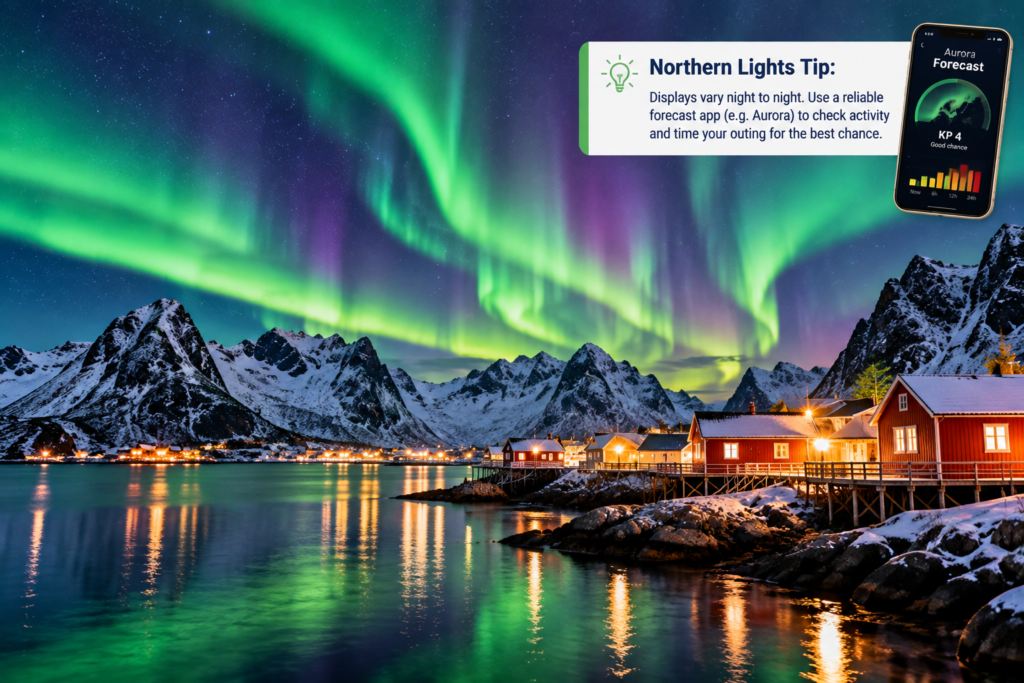
Check the aurora forecast before heading out, but do not treat an app as a guarantee. Use it alongside the local weather forecast and cloud cover.
The Yr weather service is particularly useful for checking conditions in specific locations around Tromsø.
How to reach Tromsø
Flying is the practical choice for most international travelers.
Tromsø Airport, Langnes has direct domestic connections to Oslo and other Norwegian cities, along with seasonal international services.
From Oslo, the flight takes roughly 1 hour 50 minutes.
You can also reach Tromsø by coastal ship. Hurtigruten calls at the city, making it an option if you are already traveling along Norway’s coast.
I would not drive from southern Norway just to reach Tromsø unless the road trip itself is the point of your holiday.
The distances are enormous.
If your main goal is the aurora, fly.
How long should you spend?
Allow three nights minimum for a dedicated northern lights trip.
Four or five nights is better if the aurora is the main reason you are coming.
That gives you multiple opportunities rather than gambling everything on one evening.
During summer, two or three nights can work because the appeal shifts toward hiking, boat trips, wildlife excursions, and the midnight sun.
Tromsø’s midnight sun season
The midnight sun is visible around Tromsø from approximately mid-May to late July.
This is a completely different experience from winter.
You lose the northern lights but gain long hours for outdoor activities. Hiking and boat excursions become much easier to schedule, and you can stay outside late without darkness becoming a factor.
Summer also means higher accommodation demand.
Book ahead.
Verdict: Worth the flight if you want the northern lights or Arctic summer. Skip if you have fewer than five days in Norway and your priority is the western fjords. Combining Tromsø and Bergen in a short trip can turn into an itinerary dominated by airports.
4. Lofoten Islands – Arctic Peaks and Midnight Sun
Best time: June to August for hiking and midnight sun; February to March for aurora
Lofoten is worth the extra travel time when landscapes are the priority. Sharp mountains rise directly from the sea, fishing villages line sheltered harbors, and beaches appear in places where you would expect only rock and snow.
The catch is that Lofoten is no longer an easy secret.
Its popularity has exploded, particularly in summer.
If you want to experience it properly, allow several days and book accommodation early.
What makes Lofoten different?
The scenery changes constantly as you move between islands.
Svolvær is one of the main bases and has the largest concentration of services. Further west, places such as Henningsvær, Reine, Hamnøy, Nusfjord, and Å become increasingly focused on fishing heritage, hiking, photography, and small-scale accommodation.
The traditional red rorbu cabins are part of the experience.
Many have been converted into tourist accommodation, allowing you to stay in buildings originally associated with the region’s fishing industry.
Then there are the beaches.
Haukland, Uttakleiv, and Ramberg are popular stops, while the surrounding mountains provide hiking opportunities ranging from relatively easy walks to demanding climbs.
You do not need to hike every famous trail.
Lofoten’s roads and villages already provide plenty to photograph.
How to reach Lofoten
You have several options, and the right one depends on where you are coming from.
You can fly to Svolvær Airport or Leknes Airport from larger Norwegian airports, usually with a connection.
Another option is the Bodø–Lofoten ferry. Ferries connect Bodø with ports including Moskenes, Værøy, and Røst, depending on the route and season.
You can also travel by coastal ship, with Hurtigruten serving ports in the Lofoten region.
Once you arrive, having a car makes a major difference.
Public transport exists, but Lofoten’s attractions are spread across a long chain of islands. Buses can work for a slower trip, but they limit spontaneous stops and make remote trailheads harder to reach.
If you are driving, build in extra time.
A route that looks short on Google Maps can take much longer because of narrow roads, traffic, weather, photo stops, and ferry connections.
How long should you spend?
Give Lofoten four to five days if it is one of the main destinations on your trip.
Three days is possible, but you will be selective.
A week gives you enough time to combine villages, beaches, hiking, and quieter roads without turning every day into a driving marathon.
If you have only two days, skip Lofoten and choose a destination closer to your existing route.
The journey is too long for a rushed stop.
Summer or winter?
Summer is the easier choice for first-time visitors.
From roughly late May to late July, the midnight sun provides exceptionally long daylight hours. Hiking conditions are generally more accessible, although mountain weather can still change quickly.
July and August are also the busiest months.
Accommodation can sell out well ahead of time, particularly in popular fishing villages.
Book ahead.
Winter is quieter and brings snow-covered mountains and opportunities for northern lights photography. But roads and hiking conditions become more demanding, and some businesses operate reduced hours or close seasonally.
I would choose winter only if you specifically want the Arctic winter atmosphere and aurora.
Lofoten without the crowds
The easiest mistake is following the same schedule as everyone else.
Popular viewpoints can become crowded during the middle of the day.
Start early.
Stay out later.
And consider moving beyond the most photographed sections of the archipelago.
If you have extra time, Vesterålen or Senja can be useful additions. They offer similarly dramatic northern landscapes while spreading your time across a wider area instead of concentrating it entirely around Lofoten’s most famous stops.
You do not need to abandon Lofoten.
Just avoid treating the busiest viewpoint as the entire destination.
Verdict: Worth the detour for travelers who want mountains, beaches, fishing villages, photography, and Arctic light in one trip. Skip if you’re short on time or trying to combine too many regions. Pairing Lofoten with Senja or Vesterålen works better than rushing through both in a few days.
5. Oslo – Norway’s Capital Region
Best time: Year-round
Oslo is worth one or two days, but I would not give it half of a short Norway trip. The capital is the country’s easiest entry point and a useful place to reset after a long flight, but the fjords and Arctic landscapes are usually the reason international visitors come to Norway in the first place.
Use Oslo as a start or finish.
What makes Oslo worth visiting?
Oslo has enough to fill a day without requiring complicated transportation.
Start around the waterfront. The Oslo Opera House is particularly useful because you can walk onto its sloping roof for views across the harbor.
From there, continue along the waterfront toward the city’s museums and cultural attractions.
The city also gives you easy access to several major museums, including the MUNCH Museum and the National Museum.
If you enjoy outdoor space, Oslo has another advantage: forests, lakes, and hiking areas are surprisingly close to the city center.
You do not need a car.
That makes Oslo a practical introduction to Norway before heading west or north.
How to reach Oslo
For most international visitors, Oslo is the easiest Norwegian arrival point.
Oslo Airport, Gardermoen is connected to the city by frequent trains, with the airport located roughly 50 km northeast of central Oslo.
The airport train takes around 20 minutes to Oslo Central Station on the fastest services.
From Oslo, you can continue by rail to Bergen in roughly 6.5–7.5 hours or toward Trondheim in around 6–7 hours, depending on the service.
There are also direct international rail connections toward Stockholm.
This makes Oslo particularly useful for open-jaw itineraries.
Fly into Oslo, travel overland through Norway, and fly home from Bergen or another major airport rather than unnecessarily returning to the capital.
How long should you spend?
One full day works for most first-time visitors. Two days is better if you enjoy museums, food, and city sightseeing.
If you have seven days in Norway, I would rather give an extra night to a fjord destination than extend Oslo from two nights to four.
That is the trade-off.
Oslo is good.
Western Norway is why many people came.
When should you visit?
Oslo works year-round.
Summer brings long daylight hours and outdoor dining, waterfront walks, and easy access to nearby nature.
Winter is colder and darker but can be useful if you are primarily interested in museums and indoor attractions.
Shoulder seasons can also help with accommodation costs.
Expert tip: Treat Oslo as a 1–2 day stop at the beginning or end of your trip. Do not build a short Norway itinerary around the capital unless museums, food, architecture, or urban culture are your main priorities.
Verdict: Worth the stop for logistics and a taste of Norwegian city life. Skip a long stay if you have limited days and your priority is fjords, mountains, or the Arctic.
6. Flåm & the Nærøyfjord – Norway’s Classic Car-Free Fjord Route
Best time: May to September
Flåm is one of the easiest places in Norway to experience a major fjord without renting a car. The village sits at the end of the Flåm Railway and provides access to the Nærøyfjord, which forms part of the UNESCO-listed West Norwegian Fjords property alongside Geirangerfjord.
For first-time visitors without a car, that makes Flåm unusually practical.
Why visit Flåm?
The attraction is not really the village itself.
It is the journey.
The Flåm Railway connects Flåm with Myrdal on the Bergen Railway and climbs sharply through the mountains. The route is famous for its steep gradient, tunnels, waterfalls, and changing scenery.
Then comes the fjord.
The Nærøyfjord is narrow and surrounded by steep mountains, making a boat journey through it the logical next step.
This combination is why Flåm features so prominently in the Norway in a Nutshell itinerary.
You can connect:
Oslo → Myrdal → Flåm → Nærøyfjord → Voss → Bergen
without needing to drive.
That is a major advantage in Norway, where rental cars, fuel, tolls, parking, and ferry crossings can quickly add up.
How to reach Flåm
The easiest route from Oslo is by train.
Take the Oslo–Bergen Railway to Myrdal, then change to the Flåm Railway.
The Oslo-to-Myrdal journey takes roughly 4.5–5 hours, while the Flåm Railway takes around one hour.
From Bergen, the journey can be done in reverse.
You can also book the complete Norway in a Nutshell package, which combines the relevant train, bus, and fjord boat sections into one itinerary.
That is what I would choose if you do not want to manage several separate tickets.
The alternative is booking each segment yourself.
It can sometimes give you more flexibility, but you need to coordinate the connections yourself. Leave some margin between services. A missed connection in Norway is not something you want to discover after the last bus of the day has left.
How long should you spend?
There are two good ways to approach Flåm.
Day trip: Use it as part of a Bergen–Flåm–Bergen excursion if your schedule is tight.
Overnight: Stay one night in Flåm and continue toward Bergen the following day.
I prefer the overnight option if you have the time.
Once the main daytime groups leave, the village becomes considerably calmer.
If you are short on time, however, do not force an overnight stay. The route itself is the attraction, and a well-timed day trip can cover the main experience.
Is Norway in a Nutshell worth it?
For a first-time visitor without a car, yes.
The route is specifically designed to combine Norway’s railways, buses, and fjord boats, so you can see a substantial section of western Norway without dealing with parking or mountain roads.
It is also useful for travelers who have only a few days.
But there is a trade-off.
You are following a popular route, so you will not have the same flexibility as someone driving independently.
If you want spontaneous photography stops, remote hikes, or small villages away from the standard route, rent a car and build a slower itinerary.
If you want maximum scenery with minimum logistical hassle, use public transport.
When should you visit?
May through September is the easiest period for the complete combination of rail and fjord travel.
Summer has the most frequent services and the longest daylight, but it also brings the largest crowds.
Late May and September are better if you want to take the same route with fewer people.
Book ahead during July and August, particularly if you want a specific departure time or accommodation in Flåm.
Verdict: Worth the detour for first-time visitors without a car and for anyone who wants to combine Oslo, Flåm, and Bergen efficiently. If you already have several fjord days planned around Geirangerfjord, compare the routes before adding another fjord simply for the sake of collecting destinations.
7. Senja – Norway in Miniature, Without the Crowds
Best time: June to August for hiking; September to March for aurora
Choose Senja when you want the Lofoten look without putting yourself in the middle of Lofoten’s busiest areas. The island combines sharp coastal mountains, beaches, fishing villages, and winding roads in a relatively compact road-trip setting. It is one of my preferred alternatives when the famous Arctic hotspots start feeling too crowded.
Senja is not completely undiscovered.
That is exactly why you should go before assuming it will stay quiet forever.
Why visit Senja?
The Senja National Tourist Route is the main reason to come.
It runs along the island’s dramatic western and northern coastline, linking viewpoints, beaches, villages, and short walking routes. The road itself is part of the experience.
Several stops are particularly useful:
- Bergsbotn Viewpoint: A short stop with a large view over Bergsfjorden and the surrounding mountains.
- Tungeneset: A roadside viewpoint looking toward the jagged Okshornan peaks.
- Ersfjord Beach: A striking Arctic beach surrounded by mountains.
- Husøy: A small fishing community on an island connected to Senja by road.
You can cover the highlights without hiking for hours.
That makes Senja useful for travelers who want dramatic scenery but do not want every day to revolve around demanding trails.
Senja vs. Lofoten
This is where I would make the decision simple.
Choose Lofoten for its famous villages, beaches, fishing cabins, and established tourist infrastructure.
Choose Senja for quieter roads, viewpoints, and a slower road-trip experience.
Lofoten has more restaurants, accommodation, organized tours, and iconic photography locations.
Senja feels more spread out and less polished for tourism.
That is both the advantage and the inconvenience.
If you need extensive public transportation and want to walk everywhere, Lofoten is easier.
If you have a rental car and want to explore at your own pace, Senja can be the better fit.
How to reach Senja
Driving is the easiest option.
From Tromsø, you can reach Senja by road and ferry connections depending on the season and route.
There are also ferry services connecting the island with the mainland and neighboring areas. Schedules vary, so check the timetable before building your route around a particular crossing.
The trip from Tromsø to the Senja area can take several hours depending on your destination and whether you use a ferry.
Do not treat Senja as a quick Tromsø side trip.
It deserves at least two nights.
If you are already driving toward Lofoten, Senja can also work as part of a longer northern Norway road trip.
How long should you spend?
Allow two to three nights for a focused Senja visit.
Three nights gives you enough flexibility to drive the scenic route, stop at viewpoints, take a short hike, and wait for better weather.
You can technically see the main road in a day.
I would not.
The whole point of choosing Senja over a crowded hotspot is having time to slow down.
When should you visit?
Summer is the easiest season.
The days are long, hiking trails are more accessible, and the tourist route can be explored without worrying about winter road conditions.
September can be particularly interesting.
The summer crowds have thinned, autumn colors begin appearing, and darkness returns to the Arctic.
That makes September a useful crossover month if you want both daytime sightseeing and a chance of northern lights.
For aurora trips, you can also consider October through March, but winter driving requires considerably more care.
Never choose an Arctic road trip based solely on an aurora forecast.
Weather and road conditions come first.
Verdict: Worth the detour if you want Arctic scenery but would rather avoid Lofoten’s busiest areas. Skip Senja if you have only a few days in northern Norway; Tromsø or Lofoten will be easier to fit into a short itinerary.
8. Vesterålen – The Quieter Arctic Alternative
Best time: June to August for summer landscapes; autumn and winter for aurora
Vesterålen is the choice for travelers who want northern Norway without concentrating their trip around Lofoten. The archipelago sits north of Lofoten and offers coastal villages, beaches, mountains, wildlife experiences, and long stretches of road where the pace is noticeably slower.
It is particularly useful for travelers who have already decided that Lofoten’s crowds and accommodation prices are not for them.
Why visit Vesterålen?
The biggest difference is the pace.
You are not moving from one famous viewpoint to another every 20 minutes.
Instead, Vesterålen works as a slower Arctic road trip.
The region is also known for whale watching, particularly around Andenes. Depending on the season and conditions, boat trips can provide opportunities to see species including sperm whales and other marine wildlife.
Andenes is therefore a useful base if wildlife is a bigger priority than photography.
There are also quieter coastal communities, beaches, hiking routes, and mountain viewpoints.
You get much of the Arctic landscape that draws people to Lofoten without having to follow exactly the same itinerary.
Vesterålen vs. Lofoten
The distinction is straightforward.
Lofoten has the stronger concentration of famous scenery.
Vesterålen gives you more space.
That difference matters in July and August, when Lofoten’s most photographed locations can become crowded and accommodation prices rise.
Vesterålen can also make sense if you are traveling with a rental car and prefer longer drives with fewer scheduled stops.
It is not a replacement for Lofoten in every itinerary.
If your priority is photographing Reine, Hamnøy, or the classic Lofoten fishing villages, go to Lofoten.
If your priority is wildlife, coastal scenery, and a quieter Arctic route, Vesterålen deserves serious consideration.
How to reach Vesterålen
You can fly into Stokmarknes Airport and connect onward by road.
There are also ferry connections linking parts of the region, while Hurtigruten serves ports in the area.
Driving is the most flexible option once you arrive.
From Lofoten, you can continue north by road into Vesterålen, making the two regions relatively easy to combine on a longer itinerary.
If you are starting in Tromsø, allow substantial travel time.
Northern Norway looks compact on a map.
It is not.
How long should you spend?
Allow two to four nights, depending on your priorities.
Two nights works for a focused whale-watching or coastal trip.
Three or four nights gives you time to combine wildlife, villages, viewpoints, and hiking without spending the entire day behind the wheel.
If you are combining Vesterålen with Lofoten, I would rather spend several nights moving slowly through both regions than attempt to see each one in a single rushed day.
When should you visit?
Summer provides the easiest conditions for road trips and hiking.
The midnight sun extends the usable daylight well into the night, which gives you enormous flexibility for driving and photography.
Whale watching depends on the specific location and season, so check current tour schedules before planning your dates around it.
Autumn and winter bring darker skies and therefore better conditions for aurora viewing.
The trade-off is obvious: shorter days and more demanding weather.
For an aurora-focused trip, stay several nights rather than expecting one evening to deliver perfect conditions.
Verdict: Worth considering if you want a quieter Arctic experience, especially if whale watching or road-tripping matters to you. If you have limited time, choose between Vesterålen and Lofoten rather than trying to squeeze both into a two-day northern detour.
9. Hurtigruten Coastal Voyage – Fjords and Northern Lights by Sea
Best time: Year-round; winter for aurora, summer for fjords and midnight sun
Choose the Hurtigruten Coastal Express when the journey itself is part of your Norway trip. The classic route connects Bergen and Kirkenes, stopping at 34 ports along the coast. A one-way voyage takes about 6–7 days, while the full round trip takes around 12 days, depending on the current schedule. Visit Norway
This is not simply a sightseeing cruise.
The ships also serve Norwegian coastal communities, so the experience feels different from a conventional cruise built around spending several hours in each tourist port.
Why take the coastal voyage?
The biggest advantage is logistics.
Your hotel moves with you.
You can wake up in a new part of Norway without packing another suitcase, navigating mountain roads, or booking a separate room every night.
The route passes through a long sequence of coastal landscapes and ports, including Ålesund, Trondheim, Bodø, Svolvær, Stokmarknes, Tromsø, Honningsvåg, and Kirkenes. Visit Norway
In summer, the focus is on long daylight hours, coastal scenery, and selected fjord excursions.
In winter, the darker skies create opportunities for northern lights viewing from the ship.
But do not book it solely because an operator advertises the aurora.
The lights are never guaranteed.
How long should you spend?
This depends entirely on how you use the route.
You can book shorter 2–5 day sections if you only want part of the coast. Hurtigruten currently offers coastal voyages ranging from shorter segments to full 12-day experiences. Visit Norway
A complete one-way Bergen–Kirkenes journey needs roughly six to seven days.
The full round trip is around 12 days.
For a first Norway trip, I would not automatically spend 12 days on the ship.
If you have two weeks total, you may get more variety by combining a shorter coastal section with time in Bergen, the fjords, or northern Norway.
How to reach the ship
You can board at Bergen, Ålesund, Trondheim, Bodø, Svolvær, Tromsø, or other ports along the route.
That flexibility is useful for building your own itinerary.
For example, you could spend several days in Bergen, board the coastal ship, and continue north toward Tromsø.
You do not need to start in Bergen.
If you are using the ship as transportation rather than a traditional cruise, check the exact port-to-port schedule before booking. Some stops are short, and you should not assume every port gives you enough time for a long independent excursion.
Does Hurtigruten visit Geirangerfjord?
Yes, but do not treat Geiranger as a year-round stop on the standard route.
Hurtigruten’s current summer schedule includes sailings into Geirangerfjord from June through August on northbound journeys. Outside that summer period, the itinerary uses other fjord destinations, including Hjørundfjord in the relevant season. Hurtigruten
That distinction matters if Geirangerfjord is the reason you are considering the voyage.
Check the exact 2026 sailing before paying for a cabin.
Hurtigruten or Havila?
Both Hurtigruten and Havila Voyages operate services along the Norwegian Coastal Express route. Hurtigruten has daily departures, while Havila operates several departures each week. Visit Norway
Compare the sailing date, cabin, included services, port schedule, and total price rather than choosing purely by brand.
Expert tip: Book ahead for July and August if you want a particular cabin or departure. For aurora trips, I would favor several nights in northern Norway around the voyage rather than relying on one night at sea.
Verdict: Worth it if you enjoy slow travel and want to cover large sections of the coast without repeatedly changing hotels. Skip it if you have only five or six days and would rather spend that time exploring one fjord region in depth.
10. Norway in a Nutshell – Oslo to Bergen by Rail, Fjord and Bus
Best time: Year-round; May to September for longer daylight and classic summer conditions
Norway in a Nutshell is the easiest answer to the question, “How do I see the fjords without renting a car?” The route combines the Bergen Railway, Flåm Railway, a fjord cruise through the Nærøyfjord, and bus connections into one self-guided journey. Current 2026 listings describe it as a year-round route with daily departures. Visit Norway
It is also one of the most practical choices for first-time visitors.
What happens on the route?
The classic journey links several forms of transport.
You start on the Bergen Railway, crossing the mountains between Oslo and Myrdal. The full Oslo–Bergen railway journey takes around seven hours. Visit Norway
At Myrdal, you change to the Flåm Railway.
The train descends toward Flåm through a steep mountain landscape, passing waterfalls and tunnels before reaching the fjord.
From Flåm, the route continues by boat through the Nærøyfjord, one of the protected fjord arms included within the UNESCO West Norwegian Fjords World Heritage area.
You then continue by bus toward Voss and connect with the railway to Bergen.
The exact order and connection times can vary by departure and season, so check the itinerary attached to your ticket.
How long does Norway in a Nutshell take?
One very long day is possible.
The current official listing gives Bergen departures around 08:00 and returns between approximately 18:00 and 21:00, with seasonal variation. Visit Norway
The complete Oslo–Bergen journey can also be done in one long day.
But I would not recommend treating that as the ideal version.
If you have the time, stay one night in Flåm.
You will have more breathing room, more daylight for exploring, and less risk that a delayed connection turns your entire day into a race.
Visit Norway also recommends spending a night or two around the fjord rather than simply rushing through the route. Visit Norway
Should you book the package or individual tickets?
For most first-time visitors, I would book the Norway in a Nutshell package.
The main advantage is simplicity.
The package includes the relevant train, bus, and fjord cruise tickets, with an itinerary showing how the connections fit together. Visit Norway
You can also assemble the journey yourself using individual train, ferry, and bus tickets.
That can make sense if you want to stay overnight in Flåm, spend extra time in Voss, or build a more customized route.
But calculate the total cost before assuming separate tickets will save money.
Convenience has value in Norway.
What does it cost?
Prices change with dates and availability.
For reference, the current Visit Norway listing for the 2026 Norway in a Nutshell experience shows adult prices from NOK 2,698, with children’s prices from NOK 1,204. Treat these as current advertised starting prices rather than a fixed 2026 fare for every departure. Visit Norway
Book ahead for peak summer dates.
Is it worth doing if you already visited Flåm?
Not necessarily.
This is important.
Norway in a Nutshell is a route, not a separate geographic attraction.
If you have already taken the Flåm Railway and cruised the Nærøyfjord, there is little reason to repeat the same journey simply because it appears on a top-10 list.
Use the time elsewhere.
Expert tip: For travelers worried about driving in Norway, this is the route I would recommend first. You can experience mountain railways and a major fjord without dealing with rental cars, fuel, parking, tolls, or ferry schedules.
Verdict: Worth it for first-time visitors without a car, especially when connecting Oslo and Bergen. If you have more time, turn it into a one- or two-night journey rather than squeezing everything into one long day.
Norway’s Top 10 at a Glance
The table below is more useful when the time commitment reflects the actual experience, rather than pretending every destination needs the same amount of time. Costs are relative rather than fixed because transport, accommodation, season, and booking date can change the total substantially.
| Attraction | Region | Best season | How to reach | Realistic time | Cost level |
|---|---|---|---|---|---|
| Geirangerfjord | Northwest Norway | Late May–June, September | Ferry/boat from Hellesylt or Ålesund-area routes; road; seasonal coastal voyage | 1–2 days | Moderate–High |
| Bergen & Bryggen | Western Norway | Year-round | Flight, Bergen Railway, coastal voyage | 1–2 days | Moderate |
| Tromsø | Northern Norway | September–March for aurora; May–July for midnight sun | Flight; coastal voyage | 3–4 nights for aurora | High |
| Lofoten Islands | Northern Norway | June–August; winter for aurora | Flight to Svolvær/Leknes, ferry, road | 4–5 days | High |
| Oslo | Eastern Norway | Year-round | International flights, rail | 1–2 days | Moderate |
| Flåm & Nærøyfjord | Western Norway | May–September for classic conditions | Bergen Railway, Flåm Railway, ferry, bus | 1 day; 2 days with overnight | Moderate–High |
| Senja | Northern Norway | June–August; autumn/winter for aurora | Road and seasonal ferries; from Tromsø | 2–3 nights | Moderate |
| Vesterålen | Northern Norway | Summer; autumn/winter for aurora | Flight to Stokmarknes, road, ferry, coastal voyage | 2–4 nights | Moderate |
| Hurtigruten Coastal Voyage | Coastal Norway | Year-round | Board at Bergen or intermediate ports | 2–7 days one-way section; 12 days round trip | High |
| Norway in a Nutshell | Oslo–Western Norway | Year-round | Train, fjord cruise, bus | 1 very long day; 2 days preferred | Moderate–High |
A note on timing and transport
Norway’s transport schedules change by season, and some ferry and coastal connections operate differently in summer and winter. Visit Norway specifically recommends checking Entur with your exact travel dates when planning public transport in northern Norway. Visit Norway
The same principle applies to ferries.
Popular routes can develop summer queues, and Visit Norway recommends arriving early for busy crossings such as Geiranger–Hellesylt and Bodø–Moskenes. Visit Norway
That extra 20 or 30 minutes at a ferry terminal can be the difference between staying on schedule and losing half a day.
For 2026, check the operator’s current timetable immediately before booking accommodation around a specific connection. The route may be seasonal even when the destination itself is accessible year-round.
And when a trip involves several connections, do not build your itinerary around the fastest possible transfer.
Give yourself room for weather, queues, delays, and the occasional missed ferry.
Best Time to Visit Norway: Northern Lights vs. Midnight Sun
The Seasonal Split in One Paragraph
Choose your main experience before you choose your travel dates. May through September is the practical season for fjord cruises, hiking, road trips, and long Arctic daylight, while September through March is the main window for northern lights trips above the Arctic Circle. There is some overlap in the shoulder months, but you generally cannot combine midnight-sun conditions with dark skies for aurora viewing. Your priority should decide the calendar.
That distinction makes planning Norway much easier.
If I were planning a first trip around the classic fjords, I would target late May, June, or September. If the northern lights were the main objective, I would look at September–November or February–March.
Summer: Fjords, Hiking & the Midnight Sun
Choose summer if the landscape is the priority. This is when Norway’s roads, ferries, hiking routes, fjord cruises, and mountain viewpoints are easiest to combine into one trip.
The midnight sun adds another advantage in northern Norway.
Inside the Arctic Circle, places such as Tromsø and Svolvær experience the midnight sun from roughly mid-May through late July. The exact dates vary by latitude, but the practical effect is the same: darkness largely disappears for weeks.
That changes how you can use your time.
You can finish a hike late in the evening. You can drive after dinner and still have daylight. You can photograph Lofoten’s mountains at hours when southern Norway would already be dark.
The trade-off is sleep.
Bring a sleep mask.
It sounds trivial until you are trying to sleep at 11:30 p.m. while your hotel room still looks like midday.
Why May through September works for fjords
The main western Norway attractions are easiest to connect during the warmer months.
This is the period when you can comfortably combine:
- Geirangerfjord cruises
- Nærøyfjord and Flåm
- Bergen
- Scenic road trips
- Mountain viewpoints
- Hiking
- Lofoten and Senja
- Longer daylight for photography
The shoulder months deserve particular attention.
May, June, and September can offer a better balance than the peak summer months.
July and August generally bring the highest visitor demand. Popular accommodation sells faster, roads can be busier, and major attractions feel more crowded.
By comparison, a late-May or September trip can give you more breathing room.
That does not mean guaranteed sunshine.
Norway’s weather is unpredictable, especially around the mountains and fjords.
Instead, think of the shoulder season as a crowd and price strategy, not a promise of perfect weather.
May vs. June vs. September
May: Good for lower-season travel and spring landscapes, but some mountain roads and higher hiking routes may still have snow or seasonal restrictions.
June: Longer daylight, strong conditions for road trips and hiking, and fewer peak-summer crowds than July.
July: The easiest month for full summer access, but also one of the busiest and most expensive.
August: Still excellent for outdoor travel, but demand remains high.
September: One of my preferred compromises. Darkness returns, summer crowds thin out, and the first opportunities for northern lights appear in the far north.
If you want to combine fjord scenery with a chance of aurora, September is the interesting crossover month.
Winter: The Northern Lights
Choose winter when seeing the northern lights matters more than hiking and long daylight. Above the Arctic Circle, the aurora season generally runs from autumn into early spring because you need sufficiently dark skies.
The strongest practical windows are September through November and February through March.
You can see aurora outside these periods when conditions allow, but darkness and weather are the two factors you need to manage.
I would not book a northern lights trip around one specific night.
Give yourself several.
A forecast can tell you that solar activity is promising. It cannot guarantee clear skies over your location at the exact moment the aurora appears.
Autumn or late winter?
September to November can be attractive because visitor numbers are generally lower than during the busiest winter periods.
September also gives you a useful transition between summer and winter. You still have reasonable daylight for exploring, while darkness begins returning at night.
February and March offer another good balance.
You have plenty of darkness for aurora viewing, while daylight hours are starting to increase again. Snow also remains an important part of the Arctic landscape.
March is particularly useful if you want to combine northern lights with daytime outdoor activities.
But winter travel has a cost beyond money.
Road conditions can become difficult. Weather can disrupt transport. Some attractions operate reduced schedules.
If you are uncomfortable driving on snow and ice, do not rent a car simply because it gives you more freedom.
Base yourself in Tromsø or another well-connected northern destination and use organized excursions or public transport where appropriate.
How to Plan a Northern Lights Night
You need three things:
- Darkness
- Clear skies
- Aurora activity
You cannot control the third.
You can improve the first two.
Check the aurora forecast before heading out, but also check the local cloud forecast. A strong aurora forecast is of little use if thick cloud covers the entire sky.
Get away from city lights when conditions allow.
Around Tromsø, organized aurora tours can be useful because guides can monitor weather and move toward clearer areas. Independent travelers with a rental car have more flexibility, but winter driving requires experience and caution.
Do not spend your entire evening staring at your phone.
The forecast is a planning tool, not the experience itself.
When to Book Ahead
Book early if you are traveling in July or August. This is when demand tightens fastest for popular Lofoten accommodation, fjord cruises, and coastal voyages.
I would book these first:
- Lofoten accommodation
- Geirangerfjord cruises
- Flåm and Nærøyfjord activities
- Hurtigruten or Havila sailings
- Popular summer hotels in Bergen and Geiranger
- Rental cars for western Norway road trips
You do not necessarily need to lock down every train and bus months in advance.
But accommodation in small Arctic villages and popular fjord destinations is different.
There are only so many rooms.
If your dates are fixed, book ahead rather than assuming you will find something nearby.
For September and May, you generally have more flexibility, but check individual operators because seasonal schedules can change.
My Quick Seasonal Pick
| If your priority is… | Plan your trip for… |
|---|---|
| Fjords and scenic cruises | May–September |
| Hiking | June–September |
| Lofoten road trip | June–September |
| Midnight sun | Mid-May–late July |
| Northern lights | September–March |
| Fewer summer crowds | May, June, September |
| Aurora with fewer visitors | September–November |
| Aurora + snow + increasing daylight | February–March |
| First-time balanced Norway trip | June or September |
My overall pick for a first Norway trip is September if your itinerary includes both western and northern Norway. You lose the true midnight sun, but you gain a useful compromise: fjord travel remains possible, summer crowds have eased, darkness returns in the north, and aurora opportunities begin to open up.
If the northern lights are non-negotiable, however, give them several nights.
One clear night is luck.
Several nights is planning.
How to Get Around Norway
Use trains and ferries for the classic southern route, rent a car for remote fjords and Arctic islands, and fly when the distance is simply too large. Norway looks manageable on a map, but its long coastline, mountains, fjords, and island chains make road distances deceptive.
The biggest planning mistake is trying to use one transport method for the entire country.
I would not drive from Oslo to Tromsø just to say I did it. I would also not rely entirely on public transport if my main goal were exploring remote viewpoints around Senja or western Norway’s smaller fjord roads.
Match the transport to the region.
Trains, Buses & Ferries: The Car-Free Option
Public transport is the easiest choice for a first-time Norway trip linking Oslo, Flåm, and Bergen. The rail network handles the major inland connections, while buses and ferries fill the gaps around fjords and coastal communities.
The Oslo–Bergen Railway is the backbone of the classic western Norway journey. From Myrdal, you can transfer to the Flåm Railway, then continue by boat and bus through the fjord country.
That is the basic logic behind Norway in a Nutshell.
You do not need to rent a car simply to see the major fjord scenery.
For transport planning, use Entur to search public transport connections across Norway and Vy for train services and tickets. Timetables can change by date and season, so enter your actual travel dates rather than relying on a generic route search.
Where public transport works best
Use it confidently for:
- Oslo to Bergen
- Bergen to major fjord destinations
- Flåm and Nærøyfjord
- Oslo–Myrdal–Flåm routes
- Bergen’s urban transport
- Tromsø and other larger northern towns
- Coastal travel between major ports
It becomes less convenient when you want to stop at several remote viewpoints in one day.
That is where a car starts earning its cost.
Expert tip: If your itinerary is Oslo → Flåm → Bergen, I would use trains, ferries, and buses rather than renting a car. You avoid fuel, parking, tolls and the hassle of returning a vehicle in another city.
The Coastal Voyage
Hurtigruten and Havila are useful when transportation and accommodation can be combined. Their coastal services connect Bergen and Kirkenes while calling at numerous ports along the Norwegian coast.
This makes the voyage particularly useful for travelers who want to cover long distances without driving.
You can board in Bergen and continue north through destinations including Ålesund, Trondheim, Bodø, Lofoten-area ports, and Tromsø.
The major advantage is simple:
Your accommodation moves with you.
That can save you from repeatedly packing and unpacking.
It also changes the pace of the trip. You are not rushing from one attraction to another by road. The coastal landscape becomes part of the journey.
For a dedicated coastal itinerary, compare the current schedules and cabins offered by Hurtigruten and Havila Voyages before booking.
Do not assume the cheapest cabin is automatically the best value. Check what is included and how long you will actually spend on board.
If the northern lights are your goal, remember that a coastal voyage does not guarantee an aurora.
You still need darkness, clear skies, and solar activity.
Driving in Norway
Rent a car when flexibility matters more than simplicity. This is particularly useful around western Norway and the northern islands.
A car gives you the freedom to stop at viewpoints, change plans when the weather improves, and reach places that are poorly served by public transport.
That freedom comes with a price.
You need to account for:
- Fuel
- Tolls
- Parking
- Ferry crossings
- Rental fees
- One-way drop-off charges
- Possible road closures
- Longer-than-expected driving times
Norwegian roads can also be slower than they look on a map.
A route that appears short may involve narrow roads, steep sections, ferries, tunnels, or slow-moving traffic.
Do not plan your day around the exact driving time shown by a navigation app.
Build in a buffer.
Where I would rent a car
A rental car makes the most sense for:
Geiranger and the surrounding fjords: You can combine viewpoints such as Ørnesvingen and Flydalsjuvet with smaller villages and scenic roads.
Lofoten: A car makes it much easier to reach beaches, trailheads, fishing villages, and viewpoints on your own schedule.
Senja: This is one of the places where I strongly prefer having a car. The island is spread out, and the scenic route is better when you can stop whenever the landscape changes.
Vesterålen: Driving gives you more freedom to combine villages, coastal scenery, and wildlife activities.
I would be much less enthusiastic about renting a car for a simple Oslo–Bergen–Flåm itinerary.
You are paying for flexibility you may barely use.
Do Not Underestimate Ferry Connections
This is where Norway’s transport planning gets interesting.
A ferry is sometimes part of the route, not an optional sightseeing activity.
If your itinerary requires a ferry to reach the next destination, check the current schedule before booking your accommodation.
And leave time for queues.
During busy summer periods, popular car ferries can be significantly more complicated than the timetable suggests.
I have personally learned that a missed ferry connection can disrupt an otherwise perfectly planned day.
Do not schedule a major attraction immediately after a tight ferry connection.
Give yourself room.
Domestic Flights
Fly when Norway’s geography makes overland travel inefficient. Domestic flights can save an enormous amount of time when combining southern and northern Norway.
Oslo has direct connections to major destinations including Bergen and Tromsø, while northern airports such as Svolvær, Leknes, and Stokmarknes provide access to the Lofoten and Vesterålen regions.
This is particularly useful for trips combining very distant regions.
For example:
Oslo → Bergen → Tromsø
is far more practical than trying to travel overland between all three.
Likewise, if Lofoten is the priority, flying to Svolvær or Leknes can save substantial travel time compared with traveling entirely by road from southern Norway.
The trade-off is obvious.
You see less of the country between destinations.
But if you have seven or eight days, spending an entire day in transit simply because you wanted to avoid flying is not necessarily the better travel experience.
Check Trail & Viewpoint Difficulty Before You Go
Do not assume a famous viewpoint is an easy viewpoint.
Norway’s most photographed landscapes include trails ranging from short roadside walks to steep, exposed mountain hikes.
Before setting out, check UT.no for hiking information, maps, routes, and difficulty details.
This is particularly important if you are traveling with children, older relatives, or anyone who is uncomfortable with steep terrain.
Look beyond the distance.
A 3 km hike can be considerably harder than a 5 km walk if it involves steep elevation gain, loose terrain, or exposed sections.
Weather matters too.
A trail that is straightforward in dry summer conditions can become a completely different proposition in rain, snow, or strong wind.
Check the forecast before leaving.
And do not feel pressured to complete a trail simply because it appears on every Norway itinerary.
There is no prize for reaching every viewpoint.
Sometimes the sensible decision is to turn around.
My Simple Transport Strategy for a First Norway Trip
If I were planning a 7–10 day first trip, I would avoid choosing one transport method for everything.
I would build it like this:
Oslo → Bergen: Train if I want the scenic railway experience. Fly if time is extremely tight.
Bergen → Flåm/Nærøyfjord: Train, boat, and bus.
Western fjords: Rent a car if I want to explore beyond the major public-transport routes.
Bergen → Tromsø: Fly.
Tromsø → Lofoten/Senja: Use a combination of flights, ferries, buses, or a rental car depending on how much time I have.
That gives you the best balance between convenience and flexibility.
Norway rewards slower travel, but you still need to respect the distances.
The best itinerary is not the one with the most destinations. It is the one where you are not spending half the trip getting between them.
A Realistic 10-Day First-Timer Route
Do not try to see all of Norway in 10 days. The route below deliberately combines Oslo, the classic fjords, and northern Norway, but it uses flights and coastal transport to avoid wasting days on overland travel. If you prefer a slower trip, cut either the Arctic section or Geirangerfjord rather than squeezing every destination into the schedule.
Use two fingers to move the map
Use ctrl + scroll to zoom the map
OsloCity
FlåmFjord village
BergenCity
GeirangerfjordFjord
LofotenArctic islands
TromsøArctic city
Expand
The Route at a Glance
Oslo → Flåm → Bergen → Geirangerfjord → north by coastal voyage → Lofoten → Tromsø
On paper, that looks ambitious.
It is.
The difference is that this itinerary uses each mode of transport where it makes sense. Trains handle the southern route. Boats handle the fjords and coast. A flight handles the enormous jump north.
If you try to drive the entire route, you will spend too much of your holiday behind the wheel.
Days 1-2: Oslo
Use Oslo as your arrival and recovery day, not the centerpiece of the trip.
On Day 1, keep the schedule light. Arrive, check in, and explore the waterfront around the Opera House. If your flight arrives early enough, add one museum.
Do not book a packed sightseeing schedule after a long-haul flight.
Day 2 is your proper Oslo day.
Walk through the waterfront district, visit the MUNCH Museum or National Museum, and take time for one of the city’s viewpoints or parks.
If museums are not your priority, you can see the main central sights relatively quickly.
Then prepare for the railway journey west.
Overnight: Oslo, 2 nights.
Transport: Walk and use local public transport.
Day 3: Oslo to Flåm, Then Through the Nærøyfjord to Bergen
This is your biggest sightseeing day, so start early.
Take the Bergen Railway from Oslo toward Myrdal, then change to the Flåm Railway.
The descent into Flåm is one of the highlights of the journey. Once you arrive, continue by boat through the Nærøyfjord before connecting onward toward Bergen.
This is essentially the classic Norway in a Nutshell experience.
Do not add several extra activities.
The transport itself is the attraction.
The exact connections vary by date and season, so book the itinerary for your actual travel date and check every connection before departure.
If you have more flexibility, you can break this journey with a night in Flåm. I prefer that version because it removes the pressure of making every connection in one long day.
But for a strict 10-day itinerary, continuing to Bergen keeps the route moving.
Overnight: Bergen.
Day 4: Bergen & Bryggen
Keep Day 4 flexible.
Start around Bryggen, then explore the surrounding harbor and historic streets.
Afterward, choose one direction.
Take the Fløibanen for the classic city view, or spend the afternoon on a short fjord excursion if the weather is good.
Do not try to do everything.
If the forecast is poor, stay in Bergen and use the day for museums, food, and the historic center. Save your energy for Geirangerfjord.
Overnight: Bergen.
Days 5-6: Bergen to Geirangerfjord
This is where the itinerary becomes more complicated, so leave room for transport changes.
Geiranger is not next door to Bergen.
Depending on your chosen route and the seasonal timetable, you can travel through western Norway using a combination of buses, ferries, and boats, or use a rental car for greater flexibility.
If Geirangerfjord is a major priority, I would rather give it two nights than arrive for a few hours and immediately leave.
Day 5 is primarily the transfer.
Day 6 is for the fjord.
Take a fjord cruise or boat trip to see the Seven Sisters, then visit the major viewpoints around Geiranger if road and weather conditions allow.
Ørnesvingen and Flydalsjuvet are the obvious choices.
If you have a car, Dalsnibba can also be added when the road is open and weather conditions are suitable.
Do not fill this day with six different viewpoints.
Pick two or three.
Spend the rest of the time looking at the fjord.
Overnight: Geiranger area, 2 nights.
Days 7-9: Head North – Lofoten, Senja or Vesterålen
This is the point where I would make a decision instead of trying to see all three Arctic regions.
The coastal voyage can be part of the northbound journey, but a full Bergen-to-Tromsø or Bergen-to-Lofoten journey takes time. On a strict 10-day itinerary, you need to check the exact sailing schedule before committing to this section.
If your dates align, a Hurtigruten or Havila coastal sailing gives you a memorable way to cover part of the coast while sleeping onboard.
But there is another option.
Fly north.
If Lofoten is the priority, flying closer to the islands can preserve valuable sightseeing time.
Option A: Lofoten
Choose Lofoten if this is your first Arctic trip and you want the famous fishing villages, beaches, mountain scenery, and photography locations.
Spend two or three nights around Svolvær, Henningsvær, Reine, or another base suited to your route.
A rental car is useful.
Do not attempt to photograph every famous viewpoint.
Choose a few and slow down.
Option B: Senja
Choose Senja if you want a quieter road trip.
It makes sense for travelers who have already decided they do not want the busiest Lofoten locations.
Spend two or three nights following the scenic coastal roads and viewpoints.
You will need a car or careful transport planning.
Option C: Vesterålen
Choose Vesterålen if wildlife and quieter coastal scenery appeal more than famous Instagram locations.
It is particularly interesting for travelers who want whale watching and a slower Arctic itinerary.
The important point is simple:
Pick one.
Three days is not enough to properly explore Lofoten, Senja, and Vesterålen together.
Day 10: Tromsø
Finish in Tromsø rather than trying to add another destination.
If you are traveling during the northern lights season, this is your final opportunity for an aurora outing.
If you are traveling during the midnight-sun period, use the long daylight for a final Arctic excursion.
Keep your final day reasonably flexible if you have a flight afterward.
If you have an early departure the following morning, stay close to Tromsø rather than adding a distant excursion.
Tromsø works particularly well as the final stop because you can fly onward without having to retrace your entire route south.
Overnight: Tromsø.
How I Would Adjust This Route
The itinerary above is possible, but I would not recommend it unchanged for everyone.
The biggest problem is the number of long-distance transitions.
If you have exactly 10 days and want a relaxed holiday, choose one of these versions instead.
For Fjords & Scenic Roads
Oslo → Flåm → Bergen → Geirangerfjord → Ålesund
This is the route I would choose if the classic Norway landscape is your priority.
You get more time in the fjords and less time sitting in airports.
For Northern Norway
Oslo → Bergen → Tromsø → Lofoten → Tromsø
Skip Geirangerfjord.
It sounds painful to remove such a famous destination, but geography matters more than the top-10 list.
You will have time to actually explore the Arctic instead of constantly changing regions.
For the Best Car-Free Experience
Oslo → Flåm → Bergen → fjord excursion → Tromsø
Use trains, boats, and flights.
This is the cleanest option for travelers who do not want to drive.
Two Rules That Will Save Your Trip
First: leave buffer time.
A cancelled ferry should not destroy the next three days of your itinerary.
If a connection is important, avoid scheduling another major attraction immediately afterward.
Second: do not measure Norway by the number of places you tick off.
A slower trip through two regions will usually give you a better experience than racing through five.
Norway is much larger than it looks on a typical itinerary map.
Give the landscape time to happen.
Norway on a Budget: Seeing the Icons Affordably
Norway is expensive, but you do not need a luxury budget to experience its biggest landscapes. The biggest savings usually come from choosing the right travel month, reducing unnecessary transport costs, and spending more time outdoors rather than paying for activities every day.
The weak Norwegian krone also helps international travelers.
The Weak Krone Advantage
Norway is currently more affordable for many international visitors than it was during periods when the Norwegian krone was stronger. Visit Norway has specifically highlighted the weaker krone as a factor improving Norway’s affordability for foreign travelers.
That does not make Norway cheap.
Hotels, restaurant meals, transport, and organized excursions can still add up quickly.
It simply means your home currency may stretch further than it did in previous years.
Check the exchange rate before booking and compare the final price in your own currency. Do not assume that a favorable exchange rate makes every Norwegian travel product good value.
Travel in the Shoulder Season
May, June, and September are the months I would investigate first if keeping costs under control.
July and August are the obvious summer choices, but they also bring peak demand.
Accommodation in places such as Lofoten and Geiranger can become expensive, while popular cruises and rental cars have tighter availability.
Traveling outside the busiest weeks can reduce pressure on your budget and your itinerary.
You also get another benefit.
There are fewer people competing for the same viewpoint.
Late May and September can be particularly useful for travelers who want the classic fjord experience without peak-season crowds.
Conditions are less predictable than in the middle of summer, so check seasonal transport and attraction schedules before committing.
Expert tip: Use the weaker krone and shoulder-season travel together. Saving on both exchange rates and peak-season demand is more useful than chasing tiny discounts on individual activities.
Cut Transport Costs
Transport is one of the easiest places to overspend in Norway.
A rental car gives you freedom, but the headline rental price is only part of the cost.
You may also pay for:
- Fuel
- Tolls
- Parking
- Ferry crossings
- Insurance
- One-way drop-off fees
For a route such as Oslo → Flåm → Bergen, I would use public transport.
The railway, Flåm Railway, buses, and fjord boats already form a highly practical sightseeing route.
You can also avoid paying for a vehicle on days when you are simply sitting on a train or boat.
Norway in a Nutshell is particularly useful for first-time visitors who want the classic fjord route without driving.
But do not assume a packaged route is automatically cheaper than separate tickets.
Compare the total price for your dates before booking.
Expert tip: Rent a car only for the part of the trip where you genuinely need one. A hybrid itinerary can be cheaper than keeping a rental vehicle for the entire holiday.
Choose Quieter, Cheaper Alternatives
You do not have to visit Lofoten to experience Arctic Norway.
If accommodation prices or crowds are making Lofoten difficult, look at Senja or Vesterålen.
Senja offers dramatic coastal mountains, beaches, viewpoints, and road-trip scenery.
Vesterålen provides quieter coastal landscapes and strong wildlife opportunities, including whale watching in the appropriate season.
Neither is an exact replacement for Lofoten.
That is important.
If you specifically want Reine, Hamnøy, or Lofoten’s famous fishing villages, go to Lofoten.
But if your priority is Arctic scenery rather than a particular Instagram location, compare accommodation and transport costs across all three regions.
You may find that moving slightly away from the most famous destination gives you more time and space for less money.
Free Nature, Done Right
Some of Norway’s best experiences cost nothing once you arrive.
Norway’s allemannsretten, or right to roam, gives people broad rights to access uncultivated countryside under certain conditions.
That makes hiking, walking, swimming, and experiencing the landscape relatively inexpensive compared with organized attractions.
But the right comes with responsibilities.
Follow local restrictions, respect private property, avoid damaging vegetation, and take all waste with you.
If you camp, choose appropriate locations and follow local rules around fires and protected areas.
Do not assume that “free access” means “anything goes.”
Norway’s nature is part of the attraction precisely because it remains relatively well managed.
Expert tip: Build your itinerary around free outdoor experiences, then spend your activity budget selectively on the experiences that genuinely require it, such as a fjord cruise or whale-watching trip.
Practical Planning Tips (Before You Go)
Packing & Weather
Pack for changing conditions, not a single forecast.
Norwegian weather can shift quickly, particularly around mountains and fjords.
Your basic system should include:
- A waterproof outer shell
- Warm mid-layer
- Comfortable walking shoes or hiking boots
- Moisture-wicking base layers
- Extra socks
- Hat and light gloves outside the warmest months
- Small daypack
- Reusable water bottle
Do not pack one enormous winter jacket for every season.
Layers are more useful.
You can add or remove insulation as conditions change.
And always carry a waterproof shell, even when the morning forecast looks perfect.
A sunny start does not guarantee a dry afternoon in the mountains.
Summer Sleep
If you are traveling north during the midnight-sun period, bring a sleep mask.
It sounds unnecessary until you try sleeping with daylight outside at midnight.
Blackout curtains help, but a good sleep mask takes up almost no luggage space.
Booking Strategy
Book the limited-capacity parts first.
For July and August, I would prioritize:
- Lofoten accommodation
- Geirangerfjord cruises
- Flåm accommodation and popular fjord activities
- Hurtigruten or Havila sailings
- Rental cars
- Hotels in Bergen and other high-demand destinations
You do not need to pre-book every hour of a Norway trip.
Leave some flexibility.
The important distinction is between limited supply and unlimited supply.
A small Lofoten guesthouse may have only a handful of rooms.
A city such as Oslo gives you considerably more accommodation choice.
Book the bottlenecks first.
Apps & Tools to Install
Do not rely on one app for everything.
Different tools are useful for different parts of the trip.
Visit Norway
Use the official tourism website for destination information, attractions, transport guidance, seasonal planning, and itinerary ideas.
It is particularly useful for checking current regional information before you commit to a route.
Entur
Use Entur to plan public transport connections across Norway.
It is especially useful when your journey combines trains, buses, and other public transport services.
Vy
Use Vy for Norwegian train services and relevant journey planning.
For major rail journeys, check the actual travel date rather than relying on an itinerary you found in an older travel article.
Norway Lights
Use an aurora forecasting tool such as Norway Lights when planning northern lights outings.
Treat the forecast as guidance.
It cannot guarantee that you will see an aurora.
Yr
Use Yr to check local weather and cloud conditions.
This matters more than a generic city forecast when you are planning a hike, fjord cruise, or northern lights outing.
UT.no
Use UT.no before hiking to check routes, maps, distance, elevation, and difficulty.
That is particularly important when traveling with children or anyone who is not comfortable with steep or exposed terrain.
Accessibility & Difficulty
Check the actual trail before assuming a viewpoint is accessible.
Norway’s famous photographs can make difficult locations look deceptively easy.
A viewpoint may be close to a parking area, while another may require a substantial climb.
Before setting out, check:
- Distance
- Elevation gain
- Terrain
- Estimated walking time
- Seasonal conditions
- Trail difficulty
- Weather exposure
UT.no is useful for this research.
If you are traveling with children, older relatives, or anyone with limited mobility, build the itinerary around the easiest suitable viewpoints rather than trying to reproduce someone else’s hiking itinerary.
You can still experience Geirangerfjord without climbing every mountain above it.
You can still enjoy Lofoten without completing its hardest trails.
And you can still have a great Norway trip without turning every day into a physical challenge.
The goal is to experience Norway, not to complete a checklist of difficult hikes.
Printable Seasonal Checklist
Use this checklist before booking anything. Pick your main season first, then build the itinerary around it. Norway’s geography makes last-minute changes harder than they look on a map.
Summer Checklist – May to September
Use this version if your priorities are fjords, hiking, road trips, and long Arctic daylight.
- ☐ Geirangerfjord cruise or ferry checked and booked
- ☐ Flåm Railway tickets checked and booked
- ☐ Nærøyfjord ferry tickets checked and booked
- ☐ Norway in a Nutshell package booked, or individual transport legs assembled
- ☐ Midnight-sun dates checked for Tromsø or Svolvær
- ☐ Lofoten, Senja, or Vesterålen accommodation booked
- ☐ Sleep mask packed
- ☐ Waterproof shell packed
- ☐ Lightweight warm layers packed
- ☐ Comfortable walking shoes or hiking boots packed
- ☐ Seasonal ferry and road conditions checked
- ☐ Hiking routes checked on UT.no
- ☐ Weather forecast checked before major outdoor days
Planning note: The midnight sun is roughly mid-May through late July in Tromsø and Svolvær with exact dates varying by location.
Winter Checklist – September to March
Use this version if the northern lights are the main reason for your trip.
- ☐ Norway Lights or another aurora forecast app installed
- ☐ Yr weather app installed
- ☐ Several northern lights viewing nights planned
- ☐ Viewing locations away from major city lights identified
- ☐ Tromsø or another Arctic base booked
- ☐ Hurtigruten or Havila sailing checked and booked if included in the itinerary
- ☐ Warm base layers packed
- ☐ Insulated outer layers packed
- ☐ Waterproof shell packed
- ☐ Warm hat and gloves packed
- ☐ Weather and road conditions checked before driving
- ☐ Backup indoor activities planned for cloudy or stormy nights
Planning Note: September through November and February through March are particularly useful periods for aurora trips. More nights give you better practical odds than trying to build the entire trip around one evening.
General Norway Planning Checklist
Use this section regardless of when you travel.
Route
- ☐ One or two main regions chosen
- ☐ Travel time between destinations checked
- ☐ Major attractions prioritized
- ☐ Unnecessary backtracking removed
- ☐ At least one flexible day added to a complex itinerary
Accommodation
- ☐ Lofoten accommodation booked early for July and August
- ☐ Geiranger accommodation checked early
- ☐ Flåm accommodation checked if staying overnight
- ☐ Bergen and Tromsø hotels compared before prices rise
- ☐ Accommodation location checked against transport connections
Transport
- ☐ Entur installed
- ☐ Vy installed
- ☐ Train schedules checked
- ☐ Ferry schedules checked
- ☐ Domestic flights compared for long-distance routes
- ☐ Rental car booked if needed
- ☐ Tolls, parking, and ferry costs considered when driving
- ☐ Connection times checked with realistic buffers
Weather & Hiking
- ☐ Yr installed
- ☐ UT.no installed or bookmarked
- ☐ Trail difficulty checked
- ☐ Elevation gain checked
- ☐ Seasonal road conditions checked
- ☐ Ferry and mountain-road disruptions checked before departure
- ☐ Waterproof clothing packed
Before Departure
- ☐ Passport and travel documents checked
- ☐ Travel insurance arranged
- ☐ Accommodation confirmations saved offline
- ☐ Important train, ferry, and flight bookings saved offline
- ☐ Weather forecast checked
- ☐ Emergency contacts saved
- ☐ Backup plan prepared for cancelled ferries or poor weather
- ☐ Budget checked in Norwegian kroner
- ☐ Final itinerary reviewed without overpacking each day
The One Rule to Remember
- ☐ Do not try to see all of Norway in one trip.
Pick the experiences that matter most.
A well-planned 10-day trip through two regions will usually feel far better than a 10-day race across the entire country.
If You Only Have X Days: Quick-Pick Selector
You do not need to see all 10 attractions to have a great Norway trip. Choose the route that fits your available time, then leave room for weather and transport delays.
3 Days: Oslo, Flåm & Bergen
- Day 1: Oslo
- Day 2: Norway in a Nutshell — Oslo → Flåm → Nærøyfjord → Bergen
- Day 3: Bergen & Bryggen
Why: This gives you a compact introduction to Norway’s capital, scenic railways, fjord country, and Bergen without adding a long Arctic transfer. The Norway in a Nutshell journey can be completed in one very long day, although Visit Norway recommends staying overnight around the fjord if your schedule allows.
Skip: Tromsø, Lofoten, Senja, Vesterålen, and Geirangerfjord.
7 Days: Oslo, Flåm, Bergen & Geirangerfjord
- Days 1–2: Oslo
- Day 3: Oslo → Flåm → Nærøyfjord → Bergen
- Day 4: Bergen & Bryggen
- Days 5–6: Geirangerfjord
- Day 7: Buffer day or return travel
Why: This is the better choice if the fjords are your main reason for visiting. You see the classic Flåm/Nærøyfjord route and give Geirangerfjord enough time to be more than a rushed photo stop. Geirangerfjord and Nærøyfjord form the UNESCO-listed West Norwegian Fjords property.
Do not add: Tromsø or Lofoten. The distances make the itinerary unnecessarily aggressive.
14 Days: Fjords + Arctic Norway
- Days 1–2: Oslo
- Day 3: Norway in a Nutshell to Bergen
- Day 4: Bergen
- Days 5–6: Geirangerfjord
- Days 7–9: Lofoten, Senja, or Vesterålen
- Days 10–12: Tromsø
- Days 13–14: Buffer days and onward travel
Why: Two weeks gives you enough room to combine western Norway with the Arctic without turning every day into a transfer day.
Choose Lofoten for the classic Arctic scenery and fishing villages. Choose Senja if you want a quieter road trip. Choose Vesterålen if wildlife and a slower coastal experience appeal more.
Important: Do not interpret this as a requirement to visit every destination. Two weeks is enough to combine regions, not enough to explore every corner of northern Norway.
Frequently Asked Questions
How much does a trip to Norway cost?
Norway is still an expensive destination, but the historically weak Norwegian krone has made it more affordable for many international visitors than it was in previous years. Visit Norway currently notes that the krone remains weak against several currencies and publishes 2026 reference prices for accommodation, food, and transport.
The easiest ways to control your costs are traveling outside peak summer, using public transport where practical, and spending more time on free outdoor activities.
The shoulder season can also reduce pressure on accommodation and transport availability.
I would focus on the total cost of your route rather than obsessing over individual discounts. A cheaper hotel that requires an expensive transfer may not actually save money.
When is the best time to see the northern lights?
The main northern-lights season above the Arctic Circle runs from autumn into early spring, with September–November and February–March being particularly useful periods to consider.
You need darkness, clear skies, and sufficient aurora activity.
That means no forecast can guarantee a sighting on a particular night.
Give yourself several nights if the aurora is the main reason for the trip. Autumn can also mean fewer visitors than the busiest winter period.
When is the best time to see the midnight sun?
The midnight sun occurs inside the Arctic Circle from roughly mid-May through late July, with exact dates varying by location.
Tromsø and Svolvær are both useful bases for experiencing the phenomenon.
The long daylight hours are particularly useful for hiking, photography, road trips, and late-evening excursions.
Bring a sleep mask.
You may need it more than you expect.
Do I need a car in Norway?
No. You can visit many of Norway’s major attractions without renting a car.
Trains, buses, ferries, domestic flights, and organized routes such as Norway in a Nutshell cover many of the country’s most popular destinations.
The car becomes more valuable when you want to explore remote areas at your own pace, particularly in places such as Senja, Lofoten, Vesterålen, and parts of the fjord region.
Remember that a rental car also brings fuel, tolls, parking, and ferry costs.
For a straightforward Oslo → Flåm → Bergen trip, I would skip the rental car.
How many days do I need in Norway?
Give yourself at least 5–7 days for a focused first trip, and around 10–14 days if you want to combine western Norway with the Arctic.
The exact number depends more on geography than on the number of attractions.
A seven-day trip can work very well if you focus on Oslo, Bergen, Flåm, and the fjords.
Once you add Tromsø and Lofoten, travel time becomes a much larger part of the itinerary.
Use the selector above rather than trying to fit every famous destination into one holiday.
Are Norway’s top attractions crowded?
They can be, particularly during July and August.
The most popular fjord destinations and Lofoten locations can become busy during peak summer.
If crowds are a concern, consider May, June, or September and travel outside the busiest hours where possible.
You can also change the destination.
Senja and Vesterålen provide alternatives to Lofoten for travelers who want Arctic landscapes without concentrating their entire trip around the most famous viewpoints.
Do not expect them to be completely empty. They are established destinations too.
Is Norway family-friendly and accessible?
Yes, but the accessibility of individual attractions varies considerably.
A city walk around Bergen is very different from a steep mountain trail or exposed viewpoint.
Before choosing a hike, check its distance, elevation, terrain, and difficulty.
UT.no grades Norwegian hiking routes using a national standard. Its current system includes five hiking categories, ranging from routes suitable for people with reduced mobility through increasingly demanding terrain.
This makes UT.no particularly useful when traveling with children, older relatives, or anyone who needs a less demanding route.
You do not need to complete a difficult hike to experience Norway’s scenery.
About This Guide: Sources & Fact-Check
Written From a Traveler’s Perspective
This guide is written in the voice of Daniel Morgan, an independent traveler who approaches Norway as a trip-planning problem rather than simply a collection of postcard locations.
The focus is practical: how long a destination deserves, how to connect it to the next stop, when crowds become an issue, and when a famous attraction is not worth the extra transfer for a short trip.
Personal observations and recommendations are clearly separated from verifiable travel facts.
Where an itinerary involves current transport schedules, seasonal operations, prices, or availability, check the operator’s current information before booking. Norwegian transport timetables can change between seasons.
Sources Used
The guide prioritizes primary and authoritative sources.
Statistics Norway (SSB) recorded 40.6 million guest nights at Norwegian commercial accommodation establishments in 2025, a 5.2% increase from 2024. Foreign guest nights increased by 14%, and SSB specifically noted favorable exchange rates among factors associated with the increase in foreign tourism.
Statistics Norway – 2025 accommodation statistics
UNESCO lists Geirangerfjord and Nærøyfjord together as the West Norwegian Fjords World Heritage property.
UNESCO – West Norwegian Fjords
Visit Norway provides current destination, transport, itinerary, affordability, and seasonal information used throughout this guide. Its current 2026 affordability information states that the Norwegian krone remains weak against several currencies and provides current reference prices.
Visit Norway – Is Norway expensive to visit?
For Norway in a Nutshell, Visit Norway currently lists the route as available year-round, with one-day and longer versions available. It specifically notes that travelers can spend a night or two around the fjords rather than completing the entire experience in one long day.
Visit Norway – Norway in a Nutshell
For hiking difficulty, UT.no uses a national grading system based on factors including elevation, terrain, technical challenges, and distance.
UT.no – Hiking routes and maps
Last Updated
Last Updated: September 27, 2026
Transport schedules, attraction opening dates, accommodation prices, exchange rates, ferry operations, and seasonal conditions can change. Recheck the relevant official operator immediately before departure, particularly for remote destinations and journeys involving multiple connections.
Fact-Check Commitment
TouristTrack aims to distinguish between current facts, personal recommendations, and planning estimates.
- Official facts: Supported by primary or authoritative sources.
- Personal recommendations: Presented as practical judgment rather than objective fact.
- Travel durations: Treated as realistic planning guidance and checked against current route information where available.
- Prices: Not presented as fixed unless supported by a current source.
- Seasonal operations: Rechecked against current operator or tourism information when relevant.
- Transport: Travelers should confirm final timetables before departure.
Because Norway’s transport network is highly seasonal, a timetable that was correct during one travel season may not apply to another.